


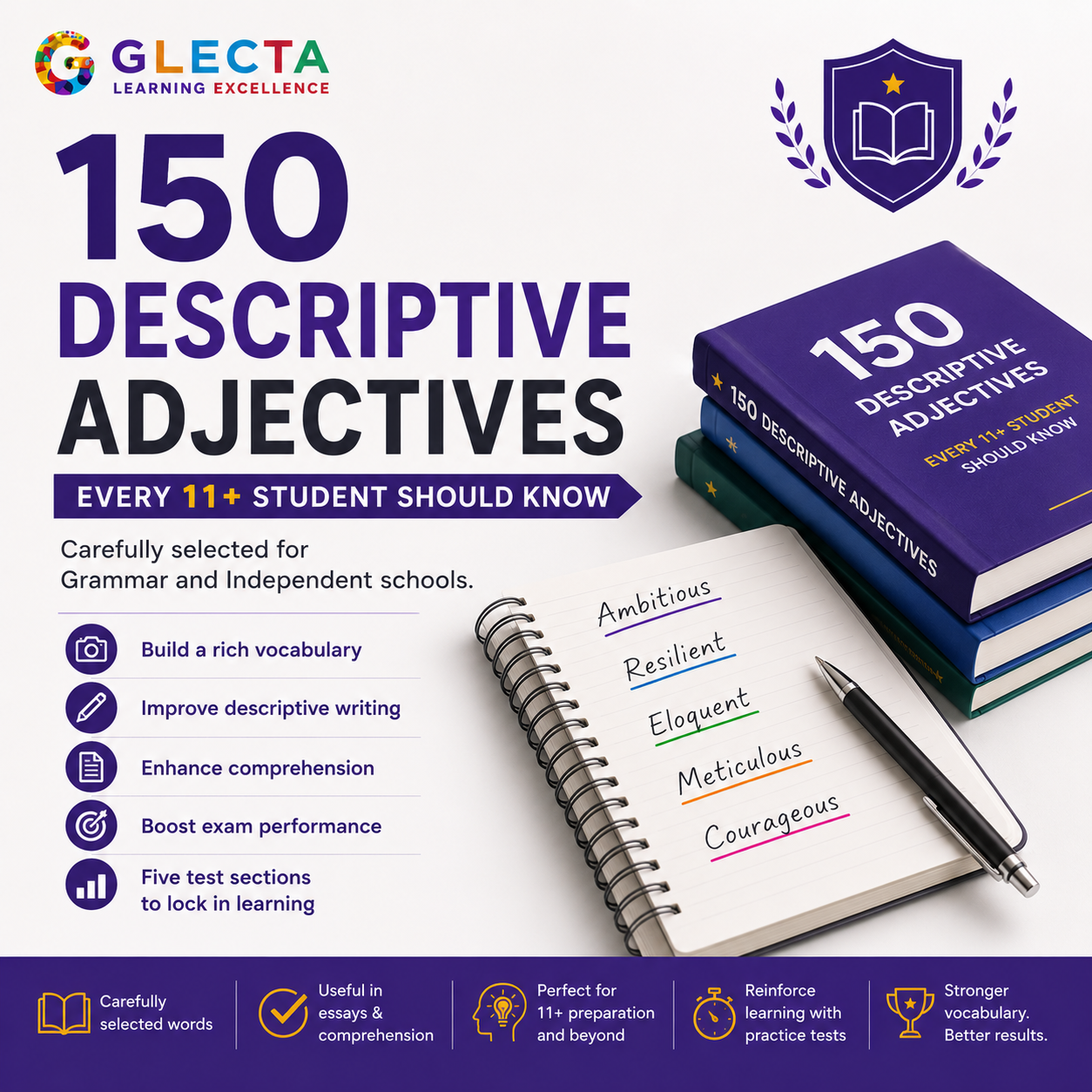
150 Descriptive Adjectives
Every 11+ Student Should Know
Carefully selected for GL, CEM, HBS, Latymer, CSSE, Sutton, Bexley and independent school entrance examinations — with five test sections to lock in learning.
📋 What's in this guide?
A strong vocabulary is one of the biggest advantages a child can have in the 11+ exam. Whether tackling comprehension, cloze passages, synonyms, antonyms, or creative writing, descriptive adjectives help students understand texts more accurately and express themselves more effectively.
Children with a rich vocabulary find it easier to infer meaning, analyse characters, and produce engaging creative writing. The 150 words below have been carefully selected because they regularly appear in high-quality literature and competitive entrance examinations. Work through the word lists first — then test yourself with the five practice sections at the bottom.
Character & Personality
These adjectives describe how people think, behave and relate to others — essential for character analysis in comprehension and effective characterisation in creative writing.
| Word | Meaning |
|---|---|
| Amiable | Friendly and pleasant |
| Arrogant | Overly proud and dismissive of others |
| Benevolent | Kind and generous in spirit |
| Callous | Unfeeling; showing no emotion or concern |
| Compassionate | Caring and sympathetic towards others |
| Courageous | Brave in the face of difficulty |
| Diligent | Hard-working and careful |
| Eccentric | Unusual; unconventional in behaviour |
| Gregarious | Fond of company; sociable |
| Humble | Modest; not boastful |
| Impulsive | Acting without thinking first |
| Jovial | Cheerful and friendly |
| Loyal | Faithful and devoted |
| Mature | Sensible and responsible |
| Noble | Honourable; having high moral principles |
| Obedient | Willing to follow instructions or rules |
| Perceptive | Quick to notice or understand things |
| Prudent | Sensible and careful about the future |
| Rational | Based on logic and reason |
| Resilient | Able to recover quickly from difficulties |
| Selfless | Putting others' needs before one's own |
| Shrewd | Clever and practically-minded |
| Sincere | Genuine; honest in feeling and expression |
| Stubborn | Unwilling to change or give way |
| Thoughtful | Considerate of others' feelings |
| Timid | Shy and easily frightened |
| Vindictive | Seeking revenge; spiteful |
| Reliable | Consistently dependable and trustworthy |
| Honest | Truthful; not deceptive |
| Polite | Well-mannered and respectful |
Positive Emotion
Examiners reward precision — avoid overused words like "happy." Use these adjectives to describe exactly how a character feels.
| Word | Meaning |
|---|---|
| Blissful | Perfectly happy; in a state of bliss |
| Content | Satisfied; peacefully happy |
| Delighted | Very pleased and excited |
| Ecstatic | Overwhelmingly joyful |
| Elated | Extremely happy and proud |
| Enthusiastic | Full of eagerness and excitement |
| Exuberant | Overflowing with energy and high spirits |
| Grateful | Thankful; appreciative |
| Hopeful | Optimistic about the future |
| Joyful | Full of happiness |
| Jubilant | Triumphantly joyful; celebrating |
| Optimistic | Positive; expecting good outcomes |
| Peaceful | Calm and undisturbed |
| Pleased | Satisfied and happy |
| Relieved | Free from anxiety or worry |
Negative Emotion
Nuanced vocabulary for sadness, anger and fear allows children to write with real emotional depth and impress comprehension markers.
| Word | Meaning |
|---|---|
| Agitated | Troubled; anxious and restless |
| Anxious | Worried; uneasy about uncertainty |
| Apprehensive | Nervous about what might happen |
| Bitter | Angry, resentful and sharp in feeling |
| Dejected | Disheartened; feeling low in spirit |
| Despondent | Feeling hopeless and without cheer |
| Disappointed | Let down by unmet expectations |
| Frustrated | Annoyed by obstacles or failures |
| Gloomy | Sad and without hope |
| Grief-stricken | Overwhelmed with deep sorrow |
| Hostile | Unfriendly; opposed and aggressive |
| Irritable | Easily annoyed or provoked |
| Melancholy | A deep, pensive sadness |
| Miserable | Very unhappy and uncomfortable |
| Remorseful | Deeply sorry for a wrongdoing |
Intelligence & Thinking
These adjectives help describe the quality of a character's mind — invaluable for analysing protagonists, antagonists and narrators in comprehension tasks.
| Word | Meaning |
|---|---|
| Analytical | Skilled at breaking down and reasoning through problems |
| Astute | Clever, sharp and quick to understand |
| Brilliant | Exceptionally intelligent |
| Cautious | Careful to avoid danger or mistakes |
| Creative | Inventive and imaginative |
| Curious | Eager to learn and discover |
| Decisive | Able to make clear decisions quickly |
| Discerning | Showing good judgement and keen insight |
| Erudite | Highly educated and knowledgeable |
| Insightful | Showing deep and accurate understanding |
| Inventive | Skilled at creating original ideas |
| Meticulous | Very careful and precise in detail |
| Observant | Quick to notice things around them |
| Sagacious | Having great practical wisdom |
| Intelligent | Able to learn, understand and think clearly |
Appearance
Character appearance descriptions are a core feature of 11+ creative writing and comprehension. These adjectives add precision and visual impact.
| Word | Meaning |
|---|---|
| Attractive | Pleasing and appealing to look at |
| Beautiful | Very attractive; possessing great beauty |
| Charming | Delightfully pleasing in appearance or manner |
| Elegant | Graceful and stylish |
| Frail | Physically weak and delicate |
| Gangly | Tall, thin and awkwardly built |
| Gorgeous | Extremely beautiful or attractive |
| Haggard | Looking exhausted or unwell |
| Neat | Tidy and well-ordered in appearance |
| Plain | Simple in appearance; not striking |
| Radiant | Glowing with health, joy or beauty |
| Scruffy | Untidy and shabby in appearance |
| Slender | Thin and graceful |
| Well-groomed | Neatly and carefully dressed and presented |
| Handsome | Good-looking; attractive |
Weather & Atmosphere
Setting the scene with precise weather vocabulary immediately lifts creative writing and shows examiners that a child can use language to create mood and atmosphere.
| Word | Meaning |
|---|---|
| Blustery | Windy with sudden gusts |
| Chilly | Unpleasantly cold |
| Cloudy | Covered or overcast with clouds |
| Damp | Slightly wet; moist |
| Dreary | Dull, grey and depressing |
| Foggy | Thick with fog; difficult to see through |
| Frosty | Covered in frost; bitingly cold |
| Humid | Warm and moist in the air |
| Misty | Partially obscured by mist |
| Overcast | Covered by thick clouds; dull |
| Stormy | Marked by violent weather |
| Sultry | Hot and heavy with humidity |
| Sunny | Bright with sunshine |
| Tempestuous | Stormy and turbulent |
| Torrential | Extremely heavy (used of rain) |
Describing Places
Strong setting descriptions are a hallmark of top-scoring creative writing. These adjectives help children paint vivid, evocative scenes in their exam stories.
| Word | Meaning |
|---|---|
| Ancient | Very old; from a distant past |
| Bustling | Full of energetic activity and movement |
| Crowded | Packed with many people |
| Derelict | Abandoned and in poor condition |
| Enormous | Extremely large in size |
| Idyllic | Pleasantly perfect; tranquil and beautiful |
| Majestic | Grand and impressively beautiful |
| Magnificent | Splendidly beautiful and impressive |
| Picturesque | Visually attractive like a picture |
| Remote | Far from other places; isolated |
| Rugged | Having a rough, uneven landscape |
| Serene | Calm, peaceful and undisturbed |
| Spacious | Large with plenty of room |
| Vast | Extremely large; immense in scale |
| Vibrant | Full of energy, colour and life |
Powerful Adjectives for Creative Writing
These high-impact words create tension, excitement and drama — the qualities that help a child's story stand out from hundreds of other scripts.
| Word | Meaning |
|---|---|
| Abrupt | Sudden and unexpected |
| Chaotic | Completely disorganised; in total disorder |
| Colossal | Extremely large; enormous |
| Dazzling | Extremely bright or impressive |
| Eerie | Strange and unsettling; mildly frightening |
| Ferocious | Violently fierce; savage |
| Fragile | Easily broken or damaged; delicate |
| Gruelling | Physically or mentally exhausting |
| Menacing | Threatening danger or harm |
| Mysterious | Difficult to understand or explain |
| Ominous | Suggesting something bad is about to happen |
| Perilous | Full of danger and risk |
| Relentless | Without stopping; persistent |
| Sinister | Suggesting evil or malice |
| Tremendous | Extremely great in size or intensity |
Nature Adjectives
Nature passages appear frequently in 11+ comprehensions. This vocabulary helps children describe natural settings with accuracy and richness.
| Word | Meaning |
|---|---|
| Blooming | Producing flowers; flourishing |
| Flourishing | Growing vigorously and healthily |
| Lush | Rich and abundant in growth |
| Pristine | In perfect, unspoiled condition |
| Rocky | Covered with or consisting of rocks |
| Sandy | Covered with or containing sand |
| Scorching | Extremely and uncomfortably hot |
| Shady | Sheltered from direct sunlight |
| Tranquil | Free from disturbance; peaceful |
| Verdant | Green with lush vegetation |
Advanced 11+ Challenge Words
These are the words that often separate average scorers from top scorers. Learn them thoroughly — they appear regularly in synonym and antonym questions.
| Word | Meaning |
|---|---|
| Ambiguous | Having more than one possible meaning |
| Archaic | Very old-fashioned; no longer current |
| Contemptuous | Showing scorn or disdain |
| Flagrant | Shockingly obvious; blatant |
| Imminent | About to happen very soon |
| Inordinate | Unusually or excessively large |
| Lucid | Clear and easy to understand |
| Mundane | Ordinary; lacking excitement |
| Negligible | So small as to be unimportant |
| Obsolete | No longer in use or current |
| Robust | Strong and healthy; vigorous |
| Stoical | Bearing pain or difficulty without complaint |
| Surreptitious | Done secretly to avoid notice |
| Vigilant | Keeping careful watch for danger |
| Wary | Cautious and watchful of danger |
🎯 How to Learn These Words Effectively
Test 1 — Synonym Match
Choose the word closest in meaning to the word in bold. Select an answer to reveal if you are correct.
Test 2 — Definition Match
Click a word on the left, then click its matching definition on the right. See how many you can get right first time!
Words
Definitions
Test 3 — Gap-Fill Challenge
Choose the correct word from the box to complete each sentence. Then click Check to see how you did.
Test 4 — Antonym Challenge
Antonym questions are common in 11+ verbal reasoning. Choose the word that is most opposite in meaning to the bold word.
Test 5 — True or False?
Read each statement carefully and decide whether it is true or false. This tests deeper understanding — not just memory.
❓ Frequently Asked Questions
Ready to Take Your Child's Vocabulary Further?
GLECTA's expert 11+ tutors help children master vocabulary, comprehension, creative writing and exam technique across all major grammar school entrance formats.