

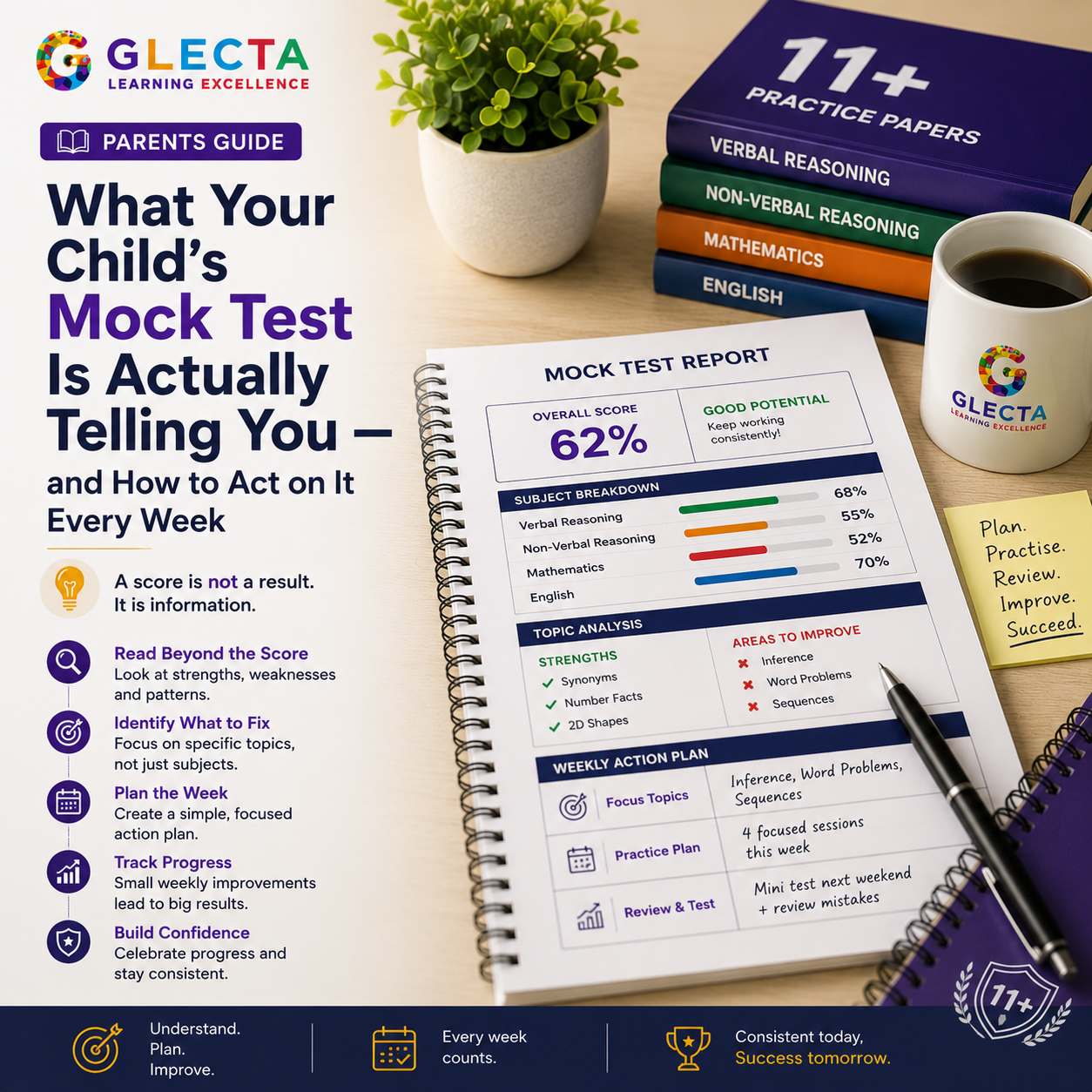

What Your Child's Mock Test Is Actually Telling You
And how to turn every single result — from June through to September — into a precise, targeted preparation plan for the week that follows.
What is in this guide
Every week between now and September, your child sits a mock exam and you look at a number. Perhaps 68%. Perhaps 74%. Perhaps an encouraging 81% that drops to 76% the following week. And you feel something — relieved, worried, confused — but you are not quite sure what to do with the information.
That uncertainty is the problem. A mock test is not a verdict. It is a diagnostic instrument. Every wrong answer in it is a precise instruction about where to spend the next seven days. Families who learn to read those instructions correctly are the ones whose children improve consistently from June to September. This guide explains exactly how to do that.
A score is a question, not an answer
Most families treat a mock result as information about their child. It is actually information about the preparation — and it tells you exactly what to do next.
When a child scores 71% on a mock paper, parents typically feel one of two things: relieved that it is not lower, or anxious that it is not higher. Both reactions treat the score as the end of the process. In reality, 71% is the beginning of the most important part of the exercise — the analysis that the 71% makes possible.
The score tells you the magnitude of the gap. The topic breakdown tells you where it lives. The individual question analysis tells you why. And the error type categorisation tells you what kind of preparation will close it. A child who scores 71% on paper and whose parent responds by simply doing more papers will plateau. A child whose parent asks "which eight questions did she get wrong, and what specifically went wrong in each one?" will improve materially within three weeks.
This is not intuitive. It requires a discipline most families do not apply, because looking at individual wrong answers feels slower and more painstaking than just moving on to the next paper. But the data is unambiguous: score improvement is almost entirely driven by understanding errors, not by volume of papers sat.
The score tells you the gap
71% means roughly 29% of marks are being lost. That is the headline. Everything that follows is about where and why those marks are going.
The topic breakdown locates it
NVR 58%, VR 79%, Maths 84%, English 73%. Now you know NVR is the gap. Not "she is weak at 11 Plus" — she is weak at one specific subject, and that subject has specific question types within it.
The question analysis explains it
Of the 12 NVR marks lost, nine came from rotation and reflection questions. The series questions were fine. Now you have a target precise enough to act on this week.
The error type prescribes the fix
Were the rotation errors wrong because she does not understand the technique, or because she does understand it but ran out of time? The answer to that question completely changes what happens in Monday's session.
How to read a mock result properly
A four-step process that takes 45 minutes after every mock and is worth more than the mock itself.
The debrief session after a mock paper is where preparation actually happens. Sitting the paper generates the data. The debrief converts that data into next week's plan. Most families skip it or reduce it to "let us look at what you got wrong" — a process that produces insights on the level of "she is weak at fractions" rather than "she divides by the wrong base when the percentage is applied to a subset, not the whole." The second version is actionable. The first is not.
Score every question individually before looking at the total
Go through every wrong answer before tallying the score. Write a single letter next to each one: K for knowledge gap, C for careless error, T for timing (did not attempt or rushed at the end). Do not allow a wrong answer to be left uncategorised. The total score can wait — the letter codes are what matter.
Map errors to specific topics, not just subjects
"Four Maths errors" is not useful. "Two ratio errors, one percentage of amount error, one data interpretation error" is. For VR, name the code type. For NVR, name the visual operation (rotation, reflection, series, matrices). The more specific the topic label, the more targeted the remediation can be.
Write the correct method in full for every K-coded error
For every knowledge-gap error, write the complete correct method in the mistake journal — not just the right answer. The act of writing the method, in the child's own words, is significantly more effective for retention than re-reading an explanation. The child who writes "to find the percentage of an amount, divide the amount by 100 then multiply by the percentage" will not make that error in the following week's mock with anything like the same frequency.
Build next week's preparation plan from the error codes
Count the K, C and T errors. Whichever letter appears most frequently determines the primary focus of the coming week. Majority K errors mean content teaching is the priority. Majority T errors mean timed drilling on those specific question types. Majority C errors mean slowing down and using a checking routine. One week later, sit the next mock and repeat the entire process from step one.
It takes approximately 45 minutes for a full paper. Your child should be present and involved — not sitting passively while you mark. They re-attempt every wrong question first before looking at the correct method. They write the correction themselves. They tell you what went wrong in their own words. This active involvement is what makes the debrief more valuable than any extra paper sat that week. A parent who marks papers alone and presents the results is doing half the work at best.
Why mock tests must start in June, not July
The children who improve most dramatically between June and September begin their mock cycle in the first week of June — not in the summer holidays.
The most common timing mistake families make is treating June as a month for content revision and July as the month to start mock testing. This logic sounds reasonable — "do the learning first, then test it" — but it misunderstands how the 11 Plus works. Mock tests are not just assessment tools. They are preparation tools. And the specific skills they build — composure under time pressure, the discipline to skip and return, stamina across a full paper, familiarity with question formats — only develop through repetition across weeks, not through knowledge revision.
A child who sits their first mock in mid-July has wasted six weeks of potential improvement data. They do not know whether their weak area is knowledge, speed or confidence. They have not built the emotional routine of sitting, completing and reviewing a full paper. And they have six fewer data points to identify recurring error patterns that would otherwise have become obvious, and fixable, by now.
The first mock paper your child sits in June is not expected to produce a high score. Its job is to show you, with precision, exactly where the preparation work needs to go. A child who scores 64% in the first June mock and 81% in the final August mock has made remarkable progress. That progress trajectory is only possible because the June mock provided accurate data early enough to act on. A child who scores 64% in a mid-July first mock has lost six weeks of that improvement curve.
Recommended mock frequency from June
| Month | Frequency | Primary purpose at this stage |
|---|---|---|
| June — Week 1 | Diagnostic mock | Establish baseline across all four subjects. This paper's topic breakdown is the foundation for all preparation decisions in June. Treat the score as irrelevant — the per-topic breakdown is everything. |
| June — Weeks 2 to 4 | Weekly | Measure whether the previous week's targeted work has closed the identified gaps. Each week's debrief compares directly with last week's error log. Are the same errors appearing again? If yes, the remediation method needs to change. |
| July | Weekly, escalating to twice weekly | Build pressure tolerance and speed. The mock is now also a performance exercise — not just what is right and wrong, but how the time was distributed across sections and whether the paper was finished. |
| August (early) | Weekly full papers | Full simulation of real exam conditions. Any persistent error patterns identified in June and July should now be largely resolved. August mocks are a quality check, not a learning exercise. |
| Final 10 days | Short sections only | No full papers. Familiar question types only, to maintain confidence and rhythm. Rest and consolidation take priority over additional data gathering at this stage. |
The three error types — and what each one demands
Applying the same remedy to every wrong answer is one of the most common and most expensive preparation mistakes a family can make.
Classifying every wrong answer by error type before deciding what to do about it is the single intervention that most consistently transforms preparation quality. The reason is simple: a knowledge-gap error and a timing error look identical in a score. A child who lost four marks because she does not know how to do ratio questions and a child who lost four marks because she ran out of time on ratio questions need completely different help. Giving the same help to both is, at best, half as effective as it should be.
Knowledge gap (K)
- The child attempted the question but used an incorrect method, or had no method at all
- What it demands: teaching the correct concept or technique, followed by three to five similar questions under light time pressure to confirm the method has embedded
- Write the correct method in full in the mistake journal — in the child's own words, not copied from the mark scheme
- Revisit the same question type in next week's mock debrief. If the error has gone, the gap is closed. If it reappears, the teaching approach needs to change
Careless error (C)
- The child knew the method but made a slip — misread the question, wrote the wrong number, performed the right calculation on the wrong figures
- What it demands: a checking routine, not more content. Teach the habit of re-reading the question after completing an answer before moving on
- Do not drill more examples of the same question type — the method is not the problem. The problem is attention
- If careless errors are the dominant error type in consecutive mocks, the child is likely working too fast. The solution is a deliberate slowdown, not acceleration
Timing error (T)
- The question was left blank or rushed because the child ran out of time in that section
- What it demands: timed speed drills on that specific question type — not to rush, but to increase fluency so the method takes fewer seconds
- Also consider whether the time was being distributed correctly across the paper. Sitting too long on one hard question is a strategy error that timed drills alone will not fix
- The skip-and-return rule — move on after 90 seconds and come back — must become automatic through practice, not instruction on exam day
When error types shift between mocks
- In early mocks, K errors dominate — knowledge gaps are the primary driver of lost marks
- In mid-preparation mocks, C errors increase as knowledge improves but speed pressure reveals attention issues
- In late mocks, T errors surface as papers get harder and time allocation becomes more critical
- This progression is healthy and expected. The error type distribution across consecutive mocks tells you whether preparation is on track more reliably than the scores themselves
The weekly action loop
Every week of preparation between now and September follows the same four-stage cycle. The content changes. The structure never does.
The families who see consistent, measurable improvement across the final three months are almost always those who follow a structured weekly cycle — not because structure is inherently valuable, but because it ensures that mock data is acted on before it goes stale. A child who sits a mock on Sunday and starts targeted remediation based on that mock on Monday will improve faster than a child who sits a mock on Sunday and begins a new unrelated topic on Monday.
Mock → Analyse → Target → Repeat
This cycle runs every seven days from the first week of June. Each stage feeds directly into the next. Breaking the cycle at any stage — sitting the mock but skipping the analysis, or doing the analysis but not adjusting the weekly preparation accordingly — dramatically reduces the improvement rate.
The mistake journal is a running record of every K error across every mock, with the correct method written alongside it. In June it fills up quickly. By July, the same question types are reappearing less often as earlier gaps close, and new, more subtle errors begin to surface. By August, a child who has maintained the journal can look back across ten weeks of entries and see, in concrete terms, exactly how much they have improved and exactly where the last remaining vulnerabilities are. That visibility is itself a confidence-building exercise that no score can replicate.
Register for multiple counties — and treat each exam as a live rehearsal
The single most underused preparation strategy available to families in the South East and surrounding counties.
There is a category of exam experience that no mock test, however well administered, can fully deliver: walking into a real examination hall, in an unfamiliar building, surrounded by 200 children you have never met, with an invigilator reading instructions you cannot ask to have repeated. The physiological response to that situation is categorically different from anything that happens at a kitchen table or even in a professional mock setting.
Children who have never experienced that environment before their primary target exam are significantly more likely to underperform in the first 10 minutes — the time it takes for the nervous system to settle, during which questions are being answered sub-optimally. Children who have already sat two or three real exams before their primary target walk in already knowing what to expect. The hall is familiar. The invigilator's instructions are expected. The sound of 200 pencils is not a surprise. They spend those first 10 minutes answering questions rather than managing an unfamiliar environment.
Think of every county exam as a live mock with genuinely high stakes — the most realistic preparation experience available. You do not need to intend to accept a place. You need the experience. Registration deadlines vary significantly by county and typically fall in the summer term. Check every county where your child is eligible and confirm the deadline this week — missing a registration window in July because you assumed it was later is one of the most avoidable preparation losses there is.
Major exams to register for
Every school listed below accepts applications from outside its immediate catchment area. Distance is not a barrier to registration — it is a question of whether the school is a realistic academic target and whether the exam experience is worth having. For most families in London and the Home Counties, several of these overlap naturally with their primary preparation and are well worth entering.
What each subject's mock results are really signalling
Different subjects fail for different reasons. Reading those reasons correctly determines whether the next week's preparation actually closes the gap or just covers it.
Low scores in different subjects are almost never caused by the same thing. A child who is underperforming in English comprehension needs a fundamentally different intervention from a child underperforming in NVR — even if both scores are 61%. The subject signals below describe what different types of underperformance in each area actually indicate, and what to do about them.
| Subject | If the score is low because of... | What it actually needs |
|---|---|---|
| Maths | Method gaps | Targeted concept teaching on specific topics — not general Maths practice. Identify the two or three topic types losing the most marks and teach those methods directly. General drilling while the method is wrong wastes sessions. |
| Maths | Multi-step freezing | The child understands individual operations but stalls on word problems requiring two or three steps. The remedy is structured problem decomposition practice — not more single-step drills. Teach the child to extract what is known, what is unknown, and what operation links them before starting any calculation. |
| English | Inference questions | The most common English failure mode in competitive papers. The child answers what the text says rather than what it implies. The specific skill to build is evidence anchoring: find the line in the passage that justifies the answer before writing anything. This is a technique, not a talent — it can be taught and drilled explicitly. |
| English | Vocabulary in context | Questions that ask what a word means as used in a specific passage are lost when the child does not know the word's meaning at all. Weekly vocabulary learning — definitions, synonyms, antonyms, example sentences — is the only remedy. There is no shortcut. Building this from June gives three months of compounding benefit. |
| Verbal Reasoning | Slow code recognition | The child can eventually get VR questions right but takes too long. The method is correct; the automatic recognition is not there yet. The remedy is repeated speed drilling on specific code types — accuracy first, then the same questions again immediately for speed. The goal is pattern recognition so fast it feels like perception, not calculation. |
| Verbal Reasoning | Analogy errors | Usually a single underlying misunderstanding about how to identify the relationship between word pairs. One focused teaching session on relationship types — function, category, degree, part-to-whole — followed by specific analogy drilling typically resolves this completely within two weeks. |
| NVR | No technique foundation | The child has been guessing rather than applying a systematic visual method. NVR technique — rotation, reflection, series, matrices — must be explicitly taught before drilling makes sense. Drilling without method teaching produces marginal improvement at significant time cost. If technique has not been taught, that comes first this week. |
| NVR | Speed after technique is solid | The method is there but accuracy drops under time pressure. Timed sets of 8 to 10 questions with a target of 40 to 45 seconds per question, working down from 60 seconds over two to three weeks. Speed in NVR responds quickly once the visual technique is automatic. |
In GL Assessment papers — the format used by Kent, Bexley, Medway and many independent schools — NVR accounts for a substantial portion of the total marks available. Among borderline candidates, NVR is the subject that most frequently separates offer from no offer, because it is the subject most families under-prepare. A child who is genuinely strong across Maths, English and VR but unreliable in NVR will consistently score below their natural ceiling. The mock result tells you this clearly every week. The question is whether you act on it.
How GLECTA fits into the weekly mock cycle
Every GLECTA service is designed to make a specific part of the weekly cycle more effective — not to replace preparation, but to accelerate it.
Independent preparation takes families a significant part of the way. Where it often falls short is in two areas: the quality of error analysis and the precision of the remediation that follows. A parent looking at a VR paper can identify that the hidden words section lost four marks. A GLECTA tutor who has seen hundreds of children fail on that specific section can tell you exactly which of the three common misunderstandings is causing it, and teach the correction in a single session. The difference in preparation efficiency is substantial.
Weekly Mock Tests
Professionally administered full papers in real exam conditions — correct desk, running stopwatch, silence, no assistance. Papers are standardised and comparable across weeks, so score trends are meaningful. Every mock includes a per-topic breakdown that feeds directly into the following week's preparation plan. This is the engine of the weekly cycle described in this guide.
Book Mock Tests →Cohort Analysis Reports
A raw percentage tells you how your child performed against a perfect score. A Cohort Analysis Report tells you how they performed against the actual competition — the children applying to the same schools this September. It reveals which topics are losing marks relative to the cohort average, and whether improvement across consecutive mocks is on a trajectory that puts an offer within reach. Families with CAR data make categorically better preparation decisions.
Learn about CAR Reports →11 Plus Mastery Courses
Small-group structured teaching across all four 11 Plus subjects, running through June, July and August. Sessions are sequenced to cover the highest-value topics in the order that preparation most needs them — not in curriculum order, but in priority order based on where the cohort data shows the most marks being lost. Children receive live technique corrections, immediate feedback on method, and exam strategies that translate directly to mock paper performance the following Sunday.
Join Mastery Course →Crash Courses
For a child with one subject or topic cluster that is significantly behind despite weekly preparation. A Crash Course compresses weeks of self-study into a focused intensive block, taught by a tutor who identifies precisely where the method is breaking down rather than teaching the entire subject from scratch. Most effective in early August, after July mock data has clearly identified the gap — with enough time remaining for the techniques to consolidate before exam day.
Book a Crash Course →Summer Mastery Courses
GLECTA's intensive summer programme runs across July and August when school has finished and preparation time expands significantly. Structured weekly sessions cover exam-relevant content with live coaching — not generic practice. The combination of morning teaching sessions and Sunday mock tests, with full debrief built into the programme, produces the fastest consistent improvement of any preparation approach across this window.
Explore Summer Programme →Private Tutoring (11 Plus)
For children who need individual attention rather than group teaching — whether because of a specific learning style, a significant gap in one subject, or a target school with a highly distinctive paper format. GLECTA's private tutors are experienced across GL Assessment, CEM, CSSE, Latymer, Sutton, Bexley, HBS and leading independent school pre-tests. Sessions are targeted entirely around the child's current error profile from mock data.
Arrange Private Tuition →The journey does not end in September
Getting into a grammar school is the beginning, not the destination. GLECTA supports students through every stage that follows.
Many families who find GLECTA during 11 Plus preparation discover that the structured, data-driven approach to identifying and closing gaps — the same approach that moved their child's mock scores from June to September — is exactly what they need again at 13+ and GCSE. Grammar schools are academically demanding environments, and the gap between a student's natural ability and their exam performance at GCSE is often as significant as it was at 11 Plus. The skills are different but the methodology is identical: identify precisely where the marks are going, apply the right remediation, and measure the result.
GCSE Tutoring
Expert one-to-one and small-group GCSE tutoring across all core subjects — Maths, English Language, English Literature, Sciences, and more. GLECTA's GCSE tutors understand the specific mark scheme demands of AQA, Edexcel and OCR papers, and teach to those demands directly. Students preparing for their mocks or final examinations receive the same systematic gap-analysis approach that makes GLECTA's 11 Plus preparation effective.
Explore GCSE Tutoring →Grammar School Transition Support
The jump from a primary school curriculum to the pace and depth of a grammar school Year 7 catches many children off guard, even those who prepared thoroughly for the 11 Plus. GLECTA offers structured Year 7 and Year 8 support for students who need to consolidate their foundation in Maths, build their analytical English skills, or simply keep pace with a faster curriculum than they have encountered before.
Year 7 and 8 Support →Subject Tutoring (KS2 to KS4)
Whether your child needs Maths support at primary level, help with English at Key Stage 3, or targeted subject tutoring ahead of Year 10 option choices, GLECTA's tutors work across the full KS2 to KS4 range. Every placement is based on a short diagnostic session to establish exactly where the gaps are and match the child with the tutor best suited to address them.
All Subject Tutoring →Children who have worked systematically through the weekly mock cycle — sitting papers, analysing errors, targeting weaknesses and measuring the result — arrive at grammar school with a structured approach to academic preparation that most of their peers do not have. They know how to identify why something went wrong, not just that it did. They know how to convert a poor test result into a specific action plan rather than a source of anxiety. These habits, built during 11 Plus preparation, pay dividends at every academic stage that follows.
What parents should and should not do in the mock cycle
The parent's involvement in the weekly cycle is genuinely important — but the type of involvement matters as much as the level of it.
Parents who are too absent from the preparation process miss the early warning signals that mock data provides. Parents who are too emotionally invested in individual scores create anxiety that measurably affects performance. The right position is informed, calm and process-focused — engaged with the methodology rather than the results.
Do: Run the debrief together, actively
Your child should be present, re-attempting wrong questions before seeing corrections, and explaining in their own words what went wrong. A passive debrief where the parent marks the paper alone and reports back produces a fraction of the retention benefit. Active involvement in diagnosing the error is part of the learning.
Do: Track the mistake journal across weeks, not just this week's entries
The journal's value compounds over time. Checking whether an error type that appeared in week two is still appearing in week six tells you whether the remediation is working. If the same error keeps returning, the teaching approach needs to change — not just be repeated more intensively.
Do not: React to individual scores emotionally in front of your child
A drop from 76% to 71% between two mocks is statistically normal and carries almost no information about whether preparation is working. A visible parental reaction to a lower score creates anxiety that genuinely affects the next mock. Children who associate lower scores with parental disappointment are less likely to attempt difficult questions — protecting their score rather than their learning. Focus responses on process observations: "you finished the VR section with three minutes spare this week, which is an improvement."
Do not: Compare your child's scores with other children's scores
A classmate who "got 84% on their mock" may have sat a different paper, at home, without a timer, with a parent present. The number is not comparable. The only meaningful comparison is your child against themselves across consecutive standardised mocks — and even then, trend matters more than any single data point. Comparisons with other children produce competitive anxiety without producing any useful preparation information.
Do not: Introduce new resources when scores fluctuate
The instinct when a score drops is to find something new — a different book, a different approach, a different tutor. This instinct is almost always wrong. Score fluctuation is normal. Switching resources at the first dip disrupts the consistency that produces improvement, introduces conflicting methods, and restarts the familiarisation process that takes weeks to build. Choose quality resources at the start of June, commit to them, and change them only if a pattern of non-improvement persists across five or more consecutive mocks.
Frequently asked questions
Start the Mock Cycle This Week
GLECTA's Weekly Mock Tests, Cohort Analysis Reports, 11 Plus Mastery Courses, Crash Courses and GCSE Tutoring are all built around the same principle: identify exactly where the marks are going, and fix it before the next paper.