

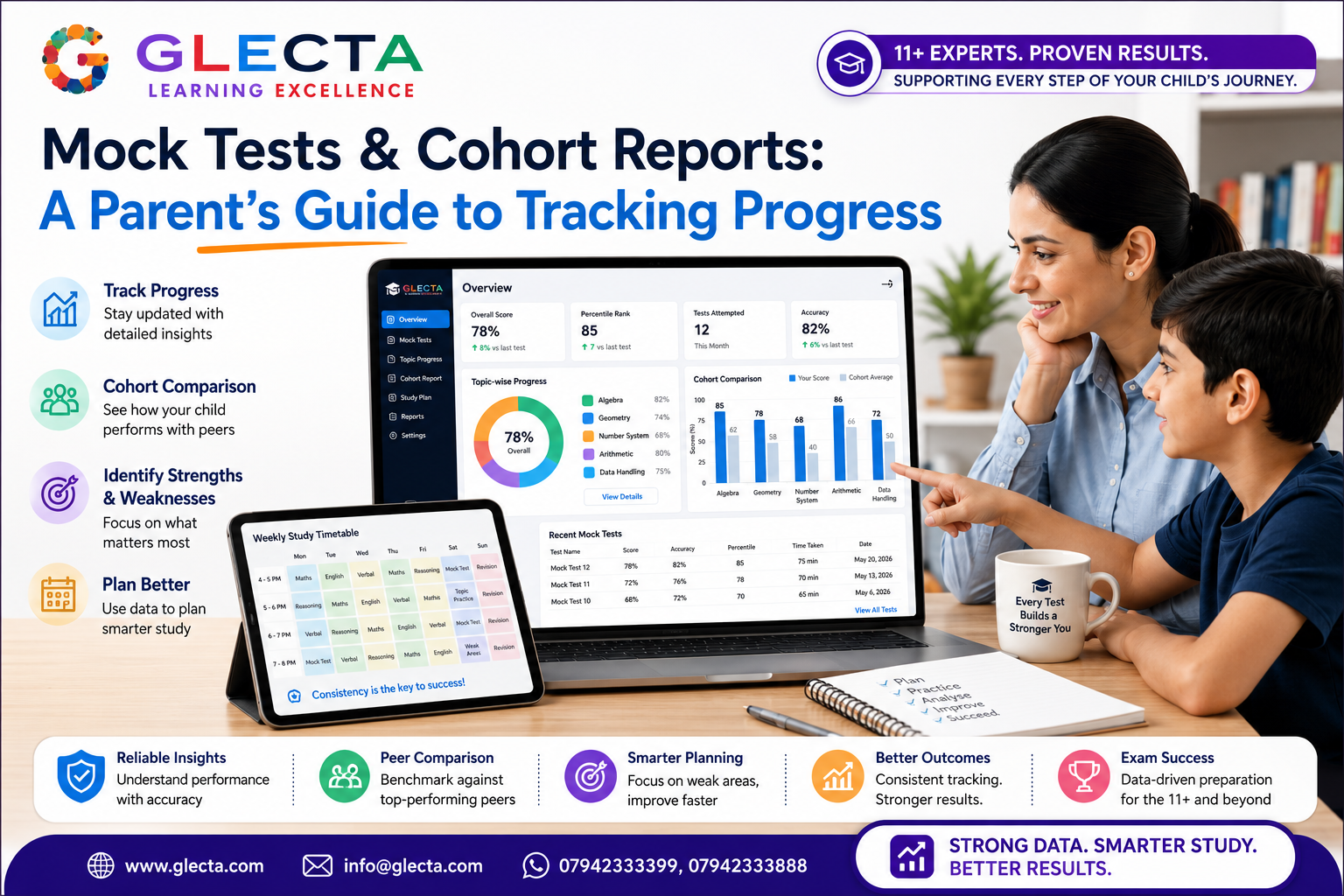

Why Mock Tests and Cohort Reports Matter More Than Ever in 11+ Preparation
A complete parent guide — what mock tests really do, why cohort reports are so powerful, how to read every metric, and how to use data to give your child a genuine competitive advantage.
The New Reality of 11+ Preparation
Preparing for the 11+ examination is no longer a matter of working through a few practice papers at home and hoping for the best. Today's grammar school entrance exams are highly competitive, increasingly data-driven, and — let's be honest — psychologically demanding for children and parents alike.
In areas such as London, Kent, Bexley, Essex, and Birmingham, thousands of children compete every year for a limited number of grammar school places. Parents invest months of time and energy into preparation — online tuition, AI tools, revision books, digital platforms. Yet one of the most powerful tools available for measuring real exam readiness is frequently underestimated:
"Mock tests and cohort reports — used intelligently — transform guesswork into evidence, and exam anxiety into quiet, earned confidence."
A child may know all the right content at home. But the real challenge begins when they walk into an exam hall, face strict timings, sit alongside unfamiliar children, hear pages turning all around them, and must deliver their best performance on a single day. That is precisely where mock tests become transformational — and where cohort reports give parents the data they need to make truly informed decisions.
This guide explains everything: what mock tests are, why they matter more than ever, how to read a cohort report, what every metric means, and — most importantly — what to do with the information once you have it.
Simulate the Real Thing
Mock tests replicate exam hall conditions — timings, silence, pressure, and answer sheet formats — so nothing on the actual day is unfamiliar.
Measure Accurately
Cohort reports replace guesswork with hard data — ranks, percentiles, topic breakdowns, and improvement trends across every mock.
Target Revision
Rather than "do more Maths," the data tells you exactly which topics, which question types, and which skills need attention this week.
Build Resilience
Children who have sat multiple mocks enter the real exam calm and familiar — because they have already been there, in every sense that matters.
What Are Mock Tests?
In simple terms, a mock test is a realistic practice examination designed to replicate the actual 11+ experience as closely as possible. The word "mock" means simulation — your child experiences the real thing before the high-stakes day itself.
A well-constructed mock test replicates exam timings, question difficulty, answer sheet formats, multi-paper structure, silent exam conditions, formal seating arrangements, and the psychological pressure of sitting alongside other candidates. Mocks are usually created in the style of the major exam boards — GL Assessment, FSCE, CSSE, SET, CEM, and Independent School entrance papers.
The purpose is not merely "more practice". The real purpose is to train the child to perform under pressure.
A Simple Real-Life Example
Brilliant at home, struggles in the exam
Solves Maths problems easily at the kitchen table. Scores 90%+ in untimed practice. Has never sat in a formal exam hall. On the day, the noise, the clock, and the pressure cause a panic. Finishes only two-thirds of the paper.
Slightly weaker academically, but exam-ready
Takes regular mocks throughout preparation. Learns to pace through sections, handles nerves through familiarity, builds stamina. In the real exam, works calmly and finishes every section with time to check.
In real 11+ exams, Student B regularly outperforms Student A — not because they know more, but because they have trained for exam conditions, not just academic content. That difference can be worth 10–20 marks on a paper where every mark counts.
GLECTA runs full 11+ mock examinations every Sunday, held in proper exam conditions across multiple venues. Detailed cohort reports are released to parents by Tuesday or Wednesday the same week — so you have the data quickly enough to act on it for the following week's revision.
Why Mock Tests Are Crucial Today
The modern 11+ landscape is far more competitive than it was even five years ago. Children are no longer competing only within their local school — they compete across entire counties and regions. Parents now use online tuition, AI tools, digital platforms, specialist mock providers, and performance analytics. The bar has risen significantly.
1. Reducing Exam Anxiety
One of the biggest hidden reasons children underperform in the 11+ is anxiety — and it is far more common than many parents realise. Many children have genuinely never sat in a large, silent exam hall. They have never heard dozens of pages turning around them. They have never experienced the physical sensation of the clock running down on a paper they cannot quite finish.
Mock tests normalise the environment. Each repeated exposure makes the experience a little less frightening and a little more familiar. Children who have sat six or eight mocks before the real exam walk in with a calm, measured confidence that cannot be bought — only built through experience.
2. Exposing Time Management Problems
Some children rush and make careless mistakes. Others spend too long on difficult questions and fail to finish sections. Either way, the problem only becomes visible under real time pressure — and the only way to experience that pressure before the actual exam is through properly run mocks.
A child may know perfectly well how to solve a question. But if they cannot solve it within 45 seconds under timed conditions, it is an exam problem — regardless of their underlying ability.
3. Providing Measurable Progress Over Time
Without mock tests, many parents rely on feelings: "I think she's improving." "He seems better at Maths now." Feelings are understandable, but they are not evidence. Mock tests replace guesswork with measurable, comparable data — and that is where cohort reports become incredibly powerful.
A child may score 85–90% at home in untimed conditions. Parents feel reassured. But the first realistic mock may reveal major timing problems, lower accuracy under pressure, and a ranking well below expectations. Discovering this early — months before the real exam — is a huge advantage. Discovering it in the exam hall is not.
The Hidden Danger of Delaying Mock Tests
One of the biggest mistakes many families make during 11+ preparation is assuming: "There's still plenty of time." In reality, timing is everything. The earlier weaknesses are discovered, the easier they are to fix calmly and systematically. The later they are discovered, the harder it becomes to repair them before the real exam.
Mock exams are not simply extra practice papers. They are diagnostic tools that reveal timing problems, weak topics, exam anxiety, careless mistakes, stamina issues, concentration problems, and gaps in understanding — while there is still enough time to address them properly.
Early Mocks vs Late Mocks — The Real Difference
Discovers comprehension timing weakness in May
Has June, July, and August to improve calmly and systematically. Works on the specific issue with full time to respond. Enters the September exam composed, having resolved the problem months ago.
Discovers the same weakness just weeks before the exam
Less time, more stress, higher pressure, and far fewer opportunities for gradual improvement. The issue may partially improve, but the process becomes rushed and emotionally exhausting for child and parent alike.
The Reality of 11+ Competition
In many grammar school areas across the UK, only around 20–30% of children achieve the qualifying standard — and in the most selective schools, the effective competition is even more intense. Thousands of children sit the same exams for a limited number of places. At this level, even small weaknesses matter.
A child may lose marks not because they lack intelligence, but because they panic under pressure, mismanage time, rush easy questions, struggle with exam stamina, or fail to finish sections. These are incredibly common issues — and they are exactly the kind of problems mock exams are designed to uncover while there is still time to fix them.
A child who regularly scores 85–90% at home in untimed conditions, with familiar surroundings and the option to ask for help, may not be as exam-ready as they appear. The first realistic mock test often reveals a very different picture. While initially disappointing, discovering this early is an enormous advantage — not a setback.
The Biggest Reasons Children Underperform in the 11+
Here is something important to understand: most children do not underperform in the 11+ because they are not capable enough. The root causes are almost always something else entirely — and every single one of them is identifiable and addressable through mock test analysis.
Poor Time Management
Many children know exactly how to solve a question — but cannot solve it quickly enough under pressure. Sections remain unfinished. Comprehension passages are rushed. Easy marks are lost to the clock rather than to lack of knowledge. This is the single most common cause of underperformance in real 11+ exams.
Exam Anxiety and Pressure
Some children score extremely highly at home but freeze in real exam settings — because they have never properly experienced a formal exam hall, strict timed pressure, or large groups of candidates. Mock exams train children emotionally as well as academically. Familiarity is the antidote to anxiety.
Hidden Topic Weaknesses
A child may appear strong overall but have quiet weaknesses in vocabulary, inference, algebra, speed arithmetic, non-verbal reasoning, or concentration. Without proper mock analysis, these weaknesses often remain hidden until very late — sometimes until the exam itself.
Lack of Performance Tracking
Without multiple mocks and cohort reports, it is very difficult to know whether mistakes are repeating, whether timing is worsening, or whether certain topics are consistently problematic. Parents may assume revision is working when the underlying weaknesses remain unchanged.
"The children who succeed in the 11+ are not always the ones who know the most. Very often, the difference comes down to timing, composure, consistency, exam temperament, and the ability to perform under pressure — skills built through intelligent mock practice."
What Is a Cohort Report?
The word "cohort" simply means a group of students taking the same test at the same time. When your child sits a mock examination alongside 200 other children, those 200 children form the cohort.
A cohort report is the detailed performance analysis produced after the mock, comparing your child's results against everyone else in that group. It is fundamentally different from a simple score sheet that says: "Your child scored 68 out of 100."
A proper cohort report answers far more important questions:
How hard was the paper?
A 68% on a very difficult paper might rank in the top 20% of the cohort. Without this context, a raw mark tells you very little.
How did they compare?
Was their score above or below the cohort average? How did they rank among all students who sat the same test that day?
Where are the weaknesses?
Which specific topics or question types are bringing the overall score down — and by exactly how much?
Speed or accuracy?
Is the problem rushing through questions carelessly, or working too carefully and leaving too many unattempted?
GLECTA runs mock exams every Sunday. Detailed cohort reports are sent to parents by Tuesday or Wednesday — giving families a full week to act on the insights before the following Sunday's mock. This rapid turnaround is deliberate: data is most useful when it is fresh and actionable.
How Cohort Reports Help Parents
Many parents, quite understandably, focus on the headline mark. "She got 74% — is that good?" But marks alone can be deeply misleading. An 85% on an easy paper with a weak cohort may be far less competitive than a 70% on a hard paper with strong candidates. Cohort reports give you the context that raw marks simply cannot provide.
Track Progress Over Time
One mock result tells you about one day. A series of results tells you a story. Cohort reports allow you to see whether your child is consistently improving, plateauing, or struggling in specific areas that have not yet been addressed in revision. The trend matters far more than any single score.
Identify Specific Weaknesses — Not Just Subjects
A child may score adequately in Maths overall while secretly struggling with multi-step ratio problems and algebra specifically. A cohort report breaks performance down topic by topic, making hidden patterns immediately visible.
Understand Relative Performance
Grammar school selection is competitive. Your child's chances depend not just on their absolute score, but on how they perform relative to every other child sitting the same examination. A cohort report gives you this picture clearly and honestly — a score without context is incomplete data.
Make Informed, Evidence-Based Decisions
With cohort data in hand, you can make smart decisions: Should you add an extra Algebra session this week? Should your child practise untimed first or dive straight into timed papers? Is English or Maths the more urgent priority right now? The data answers these questions — so decisions are evidence-based rather than guessed at.
Always read a cohort report in this order: 1) How did the whole cohort perform? (Difficulty context) → 2) Where did my child rank? (Relative performance) → 3) Which topics need attention? (Actionable next steps). Never start with the raw score in isolation.
Deep Dive Into Cohort Report Metrics & Sample Visuals
Below, we walk through each key metric in a cohort report — in plain English — alongside sample data visuals using realistic dummy data for a fictional student, Aisha, aged 10, preparing for the GL-style 11+ exam. These visuals represent the type of reporting parents receive from GLECTA's cohort system.
Sample Image 1: Cohort Report Dashboard Overview
The first thing parents see when a GLECTA report is released (Tuesday or Wednesday after Sunday's mock) is the summary dashboard — a quick snapshot of overall performance before drilling into the detail.
📋 Mock Test Report — Aisha Patel | GL-Style Mock 4 of 6
Sat: Sunday 10 May 2026 | Cohort Size: 247 students | Report released: Tuesday 12 MaySummary: Aisha performed above the cohort average across three of four subjects, with particular strength in Verbal Reasoning. Non-Verbal Reasoning remains a priority area. An attempt rate of 81% suggests time management is still leaving approximately 1 in 5 questions unattempted — a key area for this week's revision.
Sample Image 2: Student vs Cohort Score Comparison (Bar Chart)
This chart compares Aisha's score in each subject against the cohort average and the top 10% of students. Relative strengths and gaps become immediately visible — no data analysis experience required.
1. Topic-Wise Performance
This section of the cohort report breaks performance down into individual topic areas — one of the most useful elements parents receive. It immediately answers the question: "Which specific topics need attention this week?"
| Topic | Aisha's Accuracy | Cohort Average | Gap | Status |
|---|---|---|---|---|
| Fractions & Decimals | 91% | 74% | +17% | ✅ Strong |
| Algebra & Equations | 47% | 58% | −11% | ⚠️ Urgent Focus |
| Vocabulary | 83% | 71% | +12% | ✅ Strong |
| NVR Rotations | 38% | 52% | −14% | ⚠️ Urgent Focus |
| Comprehension Inference | 62% | 65% | −3% | ➡️ Monitor |
| Speed Arithmetic | 67% | 63% | +4% | ➡️ Monitor |
Sample Image 3: Topic-Wise Strengths and Weaknesses (Pie Chart)
| Status | Topics | Share |
|---|---|---|
| ✅ Strong | Fractions, VR, Vocab, Comprehension | 52% |
| ➡️ Needs Work | Speed Arith., English Writing, Sequences | 28% |
| ⚠️ Urgent | NVR Rotations, Algebra, Spatial | 20% |
Sample Image 4: Performance Over Time (Line Graph)
The line graph is one of the most important visuals in the entire cohort report — because it shows the direction of travel, not just where the child is today. A rising trend, even a gradual one, is the most important signal of genuine progress.
Sample Image 5: Historical Mock Test Comparison (Table)
This table gives a side-by-side view of subject-by-subject performance across all completed mocks. It is particularly useful for spotting which subjects are improving and which are plateauing — something a single result can never show.
| Subject | Mock 1 | Mock 2 | Mock 3 | Mock 4 | Trend |
|---|---|---|---|---|---|
| Mathematics | 61% | 65% | 70% | 76% | ↑ Strong Growth |
| English | 68% | 66% | 69% | 72% | → Steady |
| Verbal Reasoning | 71% | 74% | 80% | 85% | ↑ Excellent Growth |
| Non-Verbal Reasoning | 50% | 48% | 51% | 53% | ↔ Plateaued — Intervene |
| Overall | 62% | 65% | 72% | 78% | ↑ +16% across 4 mocks |
2. Percentile and Ranking — Explained Simply
If your child is in the 85th percentile, it means they performed better than 85% of all students who sat the same test. It does not mean they scored 85%. For grammar school entry in competitive areas, most successful candidates tend to be in the 80th–95th percentile or above, depending on the school and area.
3. Accuracy vs Attempt Rate
These two metrics together tell a story that neither can tell alone.
| Scenario | Attempt Rate | Accuracy | What It Means | Action This Week |
|---|---|---|---|---|
| Scenario A | 96% | 58% | Rushing — answers too fast, too many errors | Slow down; accuracy drills, not speed drills |
| Scenario B | 61% | 94% | Too slow — too cautious, leaving too many unattempted | Skip-and-return strategy; timed section practice |
| Scenario C | 88% | 82% | Good balance — above average performance | Address weak topics; close gap to top 10% |
4. Difficulty-Level Analysis
Strong cohort reports separate questions into easy, medium, and hard bands. A child dropping marks on easy questions has a more urgent issue than one dropping marks only on the hardest questions. Easy-question errors almost always point to carelessness or time pressure — both very fixable with the right approach.
5. Historical Trends — Same Mock Type vs Different Types
GLECTA's reporting compares performance not only across mocks, but also across different paper types — GL vs FSCE vs CSSE style. Some children perform significantly better on one format than another. Knowing this well in advance allows targeted preparation for the specific exam board your child will sit.
How to Interpret a Cohort Report — Step-by-Step Guide
Receiving a cohort report on Tuesday or Wednesday can feel overwhelming if you are not sure where to start. Here is a practical, step-by-step guide for parents to work through any report in about 20–30 minutes — without needing any data expertise.
- Ignore emotion initially — look at patterns, not feelings. Do not panic over one score, and do not feel overly reassured by one good score. A single mock is a data point, not a verdict. You are looking for trends.
- Check the cohort size and paper difficulty. A cohort of good sized students in a properly run mock is meaningfully representative. Also note whether the paper was described as harder or easier than average — this affects how to interpret the raw percentage.
- Read the percentile first, not the raw score. The percentile tells you where your child stood relative to everyone else. This is the most honest measure of competitive readiness available.
- Compare subject scores against the cohort average. For each subject, note whether your child is above or below average — and by how much. Identify the two or three subjects furthest below average.
- Read the topic-wise breakdown. Within each subject, identify the specific topics with the lowest accuracy or the biggest gap compared to the cohort. These become your revision priorities for the week ahead.
- Check the attempt rate. If your child attempted fewer than 85% of questions, time management is an issue regardless of how accurately they answered what they did attempt.
- Compare with the previous mock's report. Is the percentile improving? Are specific subjects moving in the right direction? Is the same topic repeatedly flagged? The trend tells you far more than any individual number.
Actionable Rules of Thumb
High attempts, low accuracy
Rushing. Slow down. Focus on one question at a time. Timed accuracy drills, not speed drills.
Low attempts, high accuracy
Too slow. Practise the skip-and-return strategy. 60-second maximum per question, then move on.
Weak easy questions
Concentration or panic issue. Address exam-condition practice and stress management, not content revision.
All subjects above average
Excellent. Now focus on closing the gap to the top 10%. Hard-question practice and exam technique refinement.
Weekly and Monthly Study Plan
A well-structured preparation schedule integrates GLECTA's Sunday mock sessions, Tuesday/Wednesday cohort report analysis, and targeted weekday revision into a sustainable, evidence-driven cycle. Below are sample plans you can adapt to your child's timetable.
Sample Weekly Timetable
| Day | Session Type | Duration | Focus |
|---|---|---|---|
| Monday | Topic Revision | 45 min | Priority weak topic from Sunday's report (e.g. NVR Rotations) |
| Tuesday | 📊 Report Day | 30 min | Read GLECTA cohort report; identify this week's revision priorities |
| Wednesday | English & Vocabulary | 45 min | Comprehension, inference, vocabulary building — timed practice |
| Thursday | Maths Deep Dive | 45 min | Algebra, fractions, speed arithmetic — weakest topic first |
| Friday | Mixed Timed Practice | 40 min | Timed questions across all subjects; skip-and-return practice |
| Saturday | Error Log Review | 25 min | Re-attempt previous mistakes; final preparation for tomorrow |
| Sunday | 🎯 GLECTA Mock Day | 2–3 hrs | Full mock exam under proper timed, invigilated conditions |
Sample Monthly Plan
| Week | Sunday Session | Weekday Revision Focus | Review Checkpoint |
|---|---|---|---|
| Week 1 | GLECTA Mock 1 (Diagnostic) | Identify weaknesses from Tuesday/Wednesday report | Set baseline metrics; note top 3 priority topics |
| Week 2 | GLECTA Mock 2 | Intensive work on top 2 weak topics | Mid-week accuracy check; did topic scores improve? |
| Week 3 | GLECTA Mock 3 (Progress check) | Mixed timed practice + timing strategy | Compare percentile: Week 1 vs Week 3 |
| Week 4 | No mock — consolidation week | Error log review; concept clarity on weak topics | End-of-month performance review; plan next month |
In the early stages of preparation (six or more months before the exam), one mock per fortnight is usually ideal. In the final two to three months, weekly mocks are appropriate for most children — which is exactly the cadence GLECTA's Sunday sessions support. Never sit a mock without analysing the cohort report — a mock without analysis is a missed opportunity.
Post-Mock Action Plan
The mock test is only half of the exercise. What happens in the 48–72 hours after a GLECTA mock — once the Tuesday/Wednesday report arrives — is often what determines whether real improvement follows. Many families make a critical mistake: they do the mock, glance at the score, then immediately move on. The real learning happens in the analysis.
Read the Cohort Report Together
Sit with your child and go through the GLECTA report calmly. Celebrate genuine strengths. Discuss weak areas without blame or alarm. This sets a productive tone for the week.
Three Types of Error
Conceptual — didn't understand the topic. Careless — knew it but slipped up. Time errors — ran out of time before reaching it. Each type requires a completely different response.
Record Every Mistake
Keep a dedicated notebook listing every incorrect question: the topic, the type of error, and the correct method. This becomes your most valuable revision resource over the course of multiple mocks.
Address Weaknesses That Week
Re-study the specific topics flagged in the cohort report. Do not do general practice — do targeted, focused work on exactly the areas the data identified as priorities.
Close the Loop
By Friday or Saturday, re-attempt similar questions from the same weak topic area. Can your child now answer correctly? If yes — progress made. If not — revisit the concept before Sunday's mock.
Track the Improvement
When next Tuesday/Wednesday's cohort report arrives, look specifically at the topics you targeted. Has accuracy improved? This closes the improvement loop and makes preparation genuinely evidence-based.
GLECTA Sunday Mock Examinations — Which Mock Is Right for Your Child?
GLECTA runs full, professionally invigilated mock examinations every Sunday, covering all major 11+ exam boards. Each mock is followed by a detailed cohort report released Tuesday or Wednesday — so families have data quickly enough to drive the following week's revision. Choose the mock type that matches your child's target schools.
GL Assessment Style Mock
For grammar schools using GL Assessment papers
- Mathematics — full timed paper
- English — comprehension & vocabulary
- Verbal Reasoning — 80 questions
- Non-Verbal Reasoning — shapes & patterns
- Covers: London boroughs, Hertfordshire, Buckinghamshire, Wirral and many more
- Detailed cohort report: Tuesday/Wednesday
FSCE Style Mock
For South-East and specialist school papers
- English — extended writing & comprehension
- Mathematics — reasoning & problem-solving
- Verbal Reasoning — FSCE format
- Humanities, Science & Computing — FSCE format
- Covers: CCHS, Reading, Surrey area etcs
- Harder format — strong preparation required
- Detailed cohort report: Tuesday/Wednesday
CSSE Style Mock
For Essex grammar school entrance
- English — comprehension, creative writing
- Mathematics — curriculum-based
- Covers: Chelmsford, Colchester, Southend grammar schools etc
- CSSE-specific question formats and timings
- Two separate papers replicated exactly
- Detailed cohort report: Tuesday/Wednesday
Independent School Mock
For 11+ and 13+ independent entry papers
- Mathematics — harder, multi-step problems
- English — comprehension & essay
- VR & NVR — independent school standard
- Covers: prep school entry, scholarship preparation
- Extended question types and written justification
- Detailed cohort report: Tuesday/Wednesday
Best Practices for Parents
Your role in the mock test and cohort report process is significant — and it goes well beyond organising the logistics. How you respond to results, how you frame progress, and how you support your child emotionally will have a direct impact on how they perform in the real exam.
Talk About Data, Not Worth
A low mark is information, not a verdict on your child's ability or future. Treat cohort reports as tools for improvement. "This tells us exactly where to focus next" is far more useful than any reaction to a number.
Focus on Trends, Not Single Results
One disappointing mock means very little. A downward trend across three or four mocks means a great deal. Train yourself to look at the trajectory, not the individual data point.
Let the Child Own the Error Log
Where possible, involve your child in maintaining their own error log. Children who understand their own mistake patterns take greater ownership of their revision — and that ownership drives better results.
Know When to Step Back
If a child is self-correcting, improving, and engaged, your role is to provide structure and resources. Over-involvement — reacting to every score — can increase anxiety rather than reduce it.
Know When to Intervene
If the same topic is below cohort average across three or more consecutive mocks, or if attempt rates are consistently dropping, that is the signal to seek specialist support or change the revision approach. The data tells you — trust it.
Protect Rest and Recovery
Children learn and consolidate during sleep and downtime. A rested child taking one well-analysed GLECTA mock per week will make better progress than an exhausted child sitting mocks every other day without analysis.
Mock tests reveal problems while there is still time to fix them. Cohort reports tell you exactly which problems to fix. Together, they transform 11+ preparation from a hopeful endeavour into a data-driven, targeted, and ultimately far more effective process. Start early. Analyse honestly. Act on the data. Your child's preparation will be all the stronger for it.
Quick Quiz — How Well Do You Understand Mock Tests & Cohort Reports?
Test your understanding of the key concepts covered in this guide. Eight questions — choose the best answer for each, then check your result.
Mock Tests & Cohort Reports — Parent FAQs
The questions parents ask us most often about GLECTA mock exams, cohort reports, and how to make the most of the data.
Book Your Child's First GLECTA Sunday Mock
Every Sunday. Detailed cohort reports released Tuesday or Wednesday. GL Assessment, FSCE, CSSE, SET and Independent School papers all available. Real exam conditions. Real data. Real progress.