


03 July 2026 · 13–15 min read
Introduction
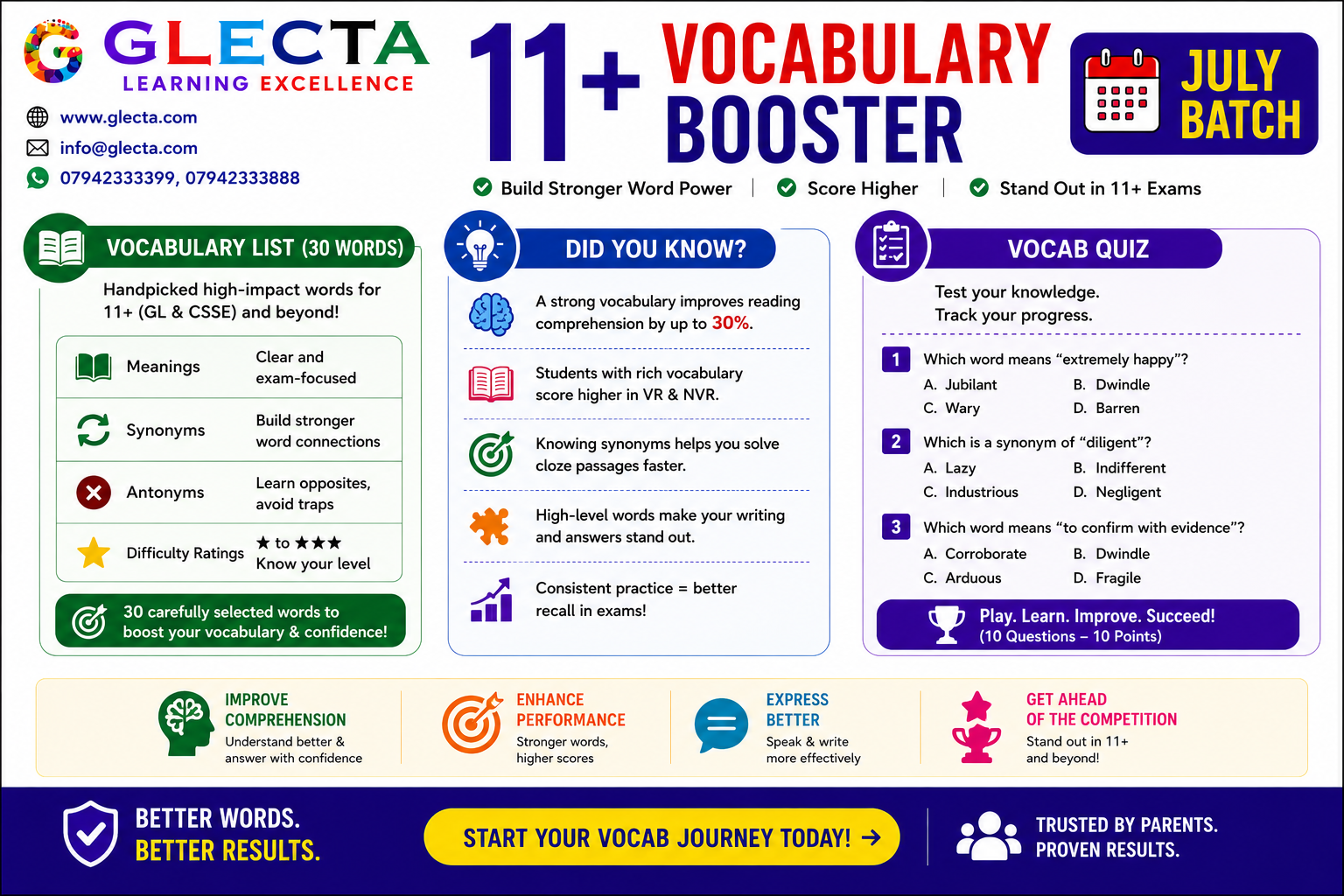
July marks the final push before live 11+ exams. With mocks behind them and real papers approaching, children need vocabulary that is not just recognised but instantly retrievable under time pressure. This is the stage where passive word lists stop working — and active, precise knowledge starts paying dividends on the mark scheme.
This July Batch delivers 30 carefully selected words — each chosen because it appears in live GL, CEM, CSSE, FSCE, and independent school papers. Several are what examiners call distractor magnets — words children almost-recognise but misuse under pressure. That is precisely why they are here.
As with previous batches, every word carries a difficulty rating (★ to ★★★) so families know exactly where to spend energy. The Word Families section adds related forms because comprehension passages regularly serve up jubilance where a child only practised jubilant. And the Thematic Groups section wires words into networks — because retrieval under time pressure works through association, not alphabetical lists.
Key for difficulty ratings:
- ★ Accessible — most Year 5 children will know this; reinforce and sharpen it
- ★★ Exam-level — high-frequency in VR and comprehension papers; deserves focused practice
- ★★★ Stretch — appears in harder papers and independent school assessments
Word List (30 Words)
GLECTA Vocabulary Builder – July Batch
| Word | Meaning | Synonyms | Antonyms | Difficulty |
|---|---|---|---|---|
| Wary | Careful because of possible danger or problems | Cautious, vigilant, guarded | Trusting, careless | ★ |
| Barren | Unable to produce much; empty or unproductive | Desolate, infertile, bleak | Fertile, productive | ★ |
| Corroborate | To confirm or support with evidence | Verify, confirm, substantiate | Contradict, refute | ★★★ |
| Dwindle | To gradually become smaller or less | Decline, diminish, lessen | Increase, expand | ★★ |
| Eccentric | Unconventional or slightly strange in behaviour | Unusual, quirky, odd | Conventional, ordinary | ★ |
| Fickle | Changing loyalties or opinions frequently; unreliable | Changeable, inconsistent, unpredictable | Loyal, constant | ★★ |
| Gallant | Brave, noble, and courteous | Courageous, valiant, heroic | Cowardly, timid | ★★ |
| Hamper | To hinder or obstruct progress | Impede, obstruct, restrict | Assist, facilitate | ★★ |
| Irksome | Annoying or irritating; causing mild frustration | Tiresome, vexing, bothersome | Pleasant, delightful | ★★★ |
| Jubilance | Great happiness and celebration; a feeling of triumph | Elation, joy, triumph | Misery, sorrow | ★★★ |
| Kindle | To ignite or inspire; to arouse a feeling or interest | Ignite, arouse, spark | Extinguish, suppress | ★★ |
| Lofty | Impressively high or noble; elevated in character or ambition | Elevated, grand, noble | Low, humble | ★★ |
| Mettle | A person's courage, determination, and resilience under pressure | Spirit, resilience, fortitude | Weakness, cowardice | ★★★ |
| Nuance | A slight difference in meaning, expression, or feeling | Distinction, subtlety, variation | Sameness, uniformity | ★★★ |
| Ornate | Highly decorated or elaborate in style | Decorative, elaborate, embellished | Plain, simple | ★★ |
| Pensive | Deep in serious, often sad, thought | Thoughtful, reflective, contemplative | Carefree, thoughtless | ★★ |
| Quench | To satisfy or extinguish a thirst, desire, or fire | Satisfy, extinguish, relieve | Ignite, intensify | ★ |
| Reconcile | To restore friendly relations or make two things compatible | Settle, resolve, harmonise | Alienate, divide | ★★ |
| Shrewd | Showing sharp judgement and practical intelligence | Astute, perceptive, wise | Foolish, gullible | ★★ |
| Thrive | To grow vigorously or prosper; to flourish | Flourish, prosper, succeed | Decline, wither | ★ |
| Unprecedented | Never done or known before; without prior example | Novel, unparalleled, exceptional | Ordinary, familiar | ★★★ |
| Voracious | Having a huge appetite or eagerness; insatiably hungry | Ravenous, insatiable, avid | Satisfied, moderate | ★★★ |
| Wholesome | Good for health or well-being; morally sound | Healthy, beneficial, nourishing | Harmful, unhealthy | ★ |
| Yearning | A deep longing or persistent desire for something | Longing, craving, desire | Satisfaction, fulfilment | ★★ |
| Zealot | A person with excessive, uncompromising enthusiasm for a cause | Fanatic, extremist, devotee | Moderate, sceptic | ★★★ |
| Bewitch | To enchant or fascinate greatly; to cast a spell over | Captivate, charm, mesmerise | Repel, bore | ★★ |
| Conspicuously | In a way that is clearly visible or noticeable to others | Noticeably, prominently, obviously | Inconspicuously, subtly | ★★★ |
| Discreet | Careful not to attract attention or reveal secrets; tactful | Circumspect, prudent, tactful | Indiscreet, careless | ★★ |
| Exemplary | Serving as an excellent model; outstanding and admirable | Outstanding, admirable, model | Poor, inferior | ★★ |
| Frivolity | Behaviour that is not serious or sensible; excessive playfulness | Foolishness, silliness, triviality | Seriousness, gravity | ★★★ |
Did You Know?
- NVR (Embedded Shapes) tip: the hidden shape is often exactly the same size as the original — it has simply been rotated or surrounded by distracting lines. Many students search for a larger or smaller version and miss the answer completely. Training your eyes to ignore extra lines and focus only on the outline improves both speed and accuracy. This is one of the most effective ways to master embedded shape questions in the 11+.
- Maths (Algebra & Missing Values) tip: many 11+ algebra questions can be solved without formally "doing algebra." Instead of memorising rules, substitute the answer choices back into the equation to see which one works. This technique is particularly useful in multiple-choice papers, where working backwards is often quicker than solving from scratch. Top-performing students know when to use the options to their advantage.
- VR (Dictionary Order) tip: questions aren't just testing whether you know the alphabet — they're testing whether you can compare words letter by letter. If two words begin with the same letters, don't stop there. Keep comparing until you find the first letter that's different. Students who master this simple habit solve alphabetical order questions much faster and make far fewer careless mistakes, especially when the words look very similar.
Word Families
Knowing one form of a word unlocks others. 11+ comprehension passages regularly use related forms — so if a child knows jubilant, they should immediately recognise jubilance when it appears mid-passage. Learn the root; the family comes free.
| Word | Related Forms | Quick Note |
|---|---|---|
| Wary | wariness (n), warily (adv), unwary (adj) | Unwary (not cautious) is its direct antonym and appears in its own right: "the unwary traveller fell straight into the trap" |
| Barren | barrenness (n), barrenly (adv) | Works both literally (barren land, barren field) and figuratively (a barren argument) — comprehension passages use both senses |
| Corroborate | corroboration (n), corroborated (past tense), corroborating (v) | Corroboration is the noun form most often found in non-fiction and legal-style passages: "the second witness provided vital corroboration" |
| Dwindle | dwindling (v/adj), dwindled (past tense) | "A dwindling supply" is a common phrase in non-fiction: the adjective form often appears in comprehension passages about resources or populations |
| Eccentric | eccentricity (n), eccentrically (adv) | Eccentricity is the noun most likely to appear in character description: "her eccentricity made her unforgettable to everyone she met" |
| Fickle | fickleness (n), fickly (adv — rare) | Fickleness is the key noun form: "the fickleness of public opinion" appears regularly in non-fiction and opinion passage comprehensions |
| Gallant | gallantly (adv), gallantry (n) | Gallantry (courage or polite attention, especially to women) appears in historical fiction: recognising it from the base word saves time under pressure |
| Hamper | hampered (past tense), hampering (v) | Works as both verb and noun (a hamper = a basket) — context distinguishes; reading the full sentence is essential in cloze passages |
| Irksome | irk (v), irksomely (adv), irksomeness (n) | The root verb irk means to annoy or irritate: "it irked him that no one listened" — knowing the verb form unlocks cloze gaps |
| Jubilance | jubilant (adj), jubilantly (adv), jubilation (n) | Jubilant (adj) and jubilation (n) are the forms most commonly tested — all three share the root and signal celebration or triumph |
| Kindle | kindled (past tense), kindling (n/v) | Kindling is the noun (material used to start a fire) but kindle as a verb works figuratively: "her speech kindled enthusiasm in even the most reluctant volunteers" |
| Lofty | loftily (adv), loftiness (n) | Used both literally (lofty towers) and figuratively (lofty ideals): examiners test the figurative sense most often in comprehension inference questions |
| Mettle | mettlesome (adj) | Do not confuse with metal or meddle — a classic homophones trap. Mettle means inner strength; metal is a material; meddle means to interfere |
| Nuance | nuanced (adj), nuances (plural n) | Nuanced (showing subtle distinctions) is the adjective form: "a nuanced argument" appears in non-fiction passages about complex topics |
| Ornate | ornately (adv), ornateness (n), ornament (n — related root) | Ornament shares the Latin root ornare (to adorn) — knowing this connects the two words and helps unlock unfamiliar vocabulary in context |
| Pensive | pensively (adv), pensiveness (n) | "She gazed pensively out of the window" — the adverb form is a classic tone clue in fiction comprehension that signals reflection or quiet sadness |
| Quench | quenched (past tense), quenching (v), unquenchable (adj) | Unquenchable (impossible to satisfy or put out) adds a powerful stretch sense: "an unquenchable thirst for knowledge" appears in inspiring non-fiction passages |
| Reconcile | reconciliation (n), reconciled (past tense), irreconcilable (adj) | Irreconcilable (impossible to resolve) is worth learning as a stretch antonym: "their differences proved irreconcilable" — the prefix ir- simply means not |
| Shrewd | shrewdly (adv), shrewdness (n) | "She made a shrewd observation" — used to describe both characters and judgements; the noun shrewdness appears in non-fiction profiles |
| Thrive | thriving (v/adj), thrived/throve (past tense), thrival (n — rare) | "A thriving business" or "a thriving community" — the adjective form is common in non-fiction passages about growth and success |
| Unprecedented | unprecedentedly (adv), precedent (n — the root) | Breaking it down: un- (not) + precedent (something that went before) — a good prefix lesson; knowing precedent unlocks both the base word and its negation |
| Voracious | voraciously (adv), voracity (n) | Used beyond food: "a voracious reader" or "a voracious appetite for knowledge" — the figurative sense appears regularly in comprehension and biography passages |
| Wholesome | wholesomely (adv), wholesomeness (n), unwholesome (antonym adj) | Unwholesome (harmful or morally unpleasant) is a useful antonym: "the unwholesome influence of the older boy" — examiners use it to test character inference |
| Yearning | yearn (v), yearningly (adv) | Functions as both noun and verb: "she felt a deep yearning" / "she yearned to return" — comprehension passages use both; recognising either form is essential |
| Zealot | zealotry (n), zealous (adj), zeal (n) | Zeal (great energy and enthusiasm) is a softer related word; zealot specifically implies excess or extremism — a key distinction examiners test |
| Bewitch | bewitched (past tense/adj), bewitching (adj/v), bewitchingly (adv) | Bewitching (enchantingly attractive) appears as an adjective: "her bewitching smile" — a classic tone and atmosphere word in fiction comprehension |
| Conspicuously | conspicuous (adj), conspicuousness (n), inconspicuous (antonym adj) | Inconspicuous (not attracting attention) is its direct antonym and is equally common in papers: knowing the prefix in- instantly doubles the vocabulary gain |
| Discreet | discretion (n), discreetly (adv), indiscreet (antonym adj) | Do not confuse with discrete (separate, distinct) — a classic spelling and meaning trap that examiners use deliberately in cloze and comprehension passages |
| Exemplary | exemplarily (adv), example (n — root), exemplify (v) | Exemplify (to be a typical example of) shares the root and appears in its own right: "her behaviour exemplified everything the school valued" — knowing the family avoids confusion |
| Frivolity | frivolous (adj), frivolously (adv) | Frivolous (not serious or sensible) is the adjective form and is more common in papers than the noun: "a frivolous remark at the wrong moment" — both forms are worth drilling |
Thematic Groups
Comprehension passages use vocabulary in clusters. A scene of bravery naturally brings gallant, mettle, and unprecedented together. A character study weaves in discreet, shrewd, and fickle. Learning words by theme means your child spots them by association during the exam, not just in isolation. Here are the four groups for this batch:
Group 1 — Emotions & Feelings
Pensive, Jubilance, Yearning, Irksome, Fickle
These describe inner emotional or psychological states. In comprehension, they appear as clues to a character's mood or frame of mind. Ask: is this emotion positive, negative, or somewhere in between? That question alone helps children narrow down the correct synonym under time pressure.
Group 2 — Character & Behaviour
Gallant, Wary, Discreet, Exemplary, Shrewd, Zealot, Eccentric, Conspicuously
These reveal how a person behaves and what kind of person they are. In fiction comprehension, they are the inference vocabulary — what the passage is implying without stating directly. In creative writing, swapping a flat adjective like "brave" for gallant or "clever" for shrewd lifts a sentence immediately.
Group 3 — Actions & Physical States
Hamper, Dwindle, Kindle, Quench, Thrive, Bewitch, Corroborate, Reconcile
These describe what happens to things or people. In cloze passages, the gap is often one of these — check that the chosen word fits both the meaning and the grammar of the sentence. Several (Hamper, Kindle, Quench) also carry figurative senses: the sentence must decide which is being used.
Group 4 — Abstract & Conceptual
Barren, Lofty, Mettle, Nuance, Ornate, Unprecedented, Voracious, Wholesome, Frivolity
These are the highest-value group because they describe ideas, qualities, and states that cannot be pointed at. They appear most often in non-fiction passages (history, science, journalism) and in VR synonym questions. Knowing their noun forms — mettle, nuance, voracity, frivolity — is especially important for Year 6 and independent school papers.
Usage Examples
- Wary: "She was wary of the shortcut through the woods — it looked quiet, but she had heard too many stories."
- Barren: "After the drought, the once-green hillside had become barren and cracked."
- Corroborate: "A second scientist stepped forward to corroborate the team's findings, adding her own data to the report."
- Dwindle: "As the weeks passed, the community's enthusiasm began to dwindle until barely a dozen people turned up."
- Eccentric: "The professor was eccentric in the best possible way — his lessons were bizarre, but nothing you learned there was ever forgotten."
- Fickle: "Public opinion proved fickle: the same policy that was celebrated in spring was being attacked by autumn."
- Gallant: "The young soldier's gallant attempt to hold the bridge alone had become the stuff of local legend."
- Hamper: "The unexpected roadworks continued to hamper deliveries, costing the company thousands each day."
- Irksome: "He found the constant interruptions irksome, though he was too polite to say so directly."
- Jubilance: "The crowd's jubilance at the final whistle was unlike anything the stadium had witnessed in years."
- Kindle: "A single inspiring teacher can kindle a love of reading that lasts a lifetime."
- Lofty: "Her lofty ideals were admirable, but her critics argued they were impossible to turn into policy."
- Mettle: "The unexpected setback tested the team's mettle, and they came through it stronger than before."
- Nuance: "The translator struggled to capture every nuance of the original speech — some things simply cannot be converted word for word."
- Ornate: "The ornate ceiling of the palace hall was covered in gold leaf and tiny painted figures."
- Pensive: "She sat by the window in a pensive mood, turning the letter over in her hands without opening it."
- Quench: "No amount of cold water seemed able to quench his thirst after the long morning run."
- Reconcile: "It took years for the two families to reconcile after the dispute over the land."
- Shrewd: "Her shrewd assessment of the situation saved the company from a very costly mistake."
- Thrive: "Unusual as it seemed, the cactus had begun to thrive in the cold, damp corner of the greenhouse."
- Unprecedented: "The speed of the scientific response was unprecedented — nothing like it had been seen in the history of medicine."
- Voracious: "She was a voracious reader, finishing three books a week and always starting a fourth before she slept."
- Wholesome: "The farm offered wholesome food, fresh air, and a welcome break from the city's noise."
- Yearning: "There was a deep yearning in his voice whenever he spoke about the village where he had grown up."
- Zealot: "She had once been a passionate campaigner, but years of failure had turned her into something of a zealot — unwilling to consider any compromise."
- Bewitch: "The music seemed to bewitch everyone in the room — conversations stopped and heads turned without anyone quite knowing why."
- Conspicuously: "He was conspicuously absent from the celebration, and everyone noticed."
- Discreet: "She was discreet about what she had seen, mentioning it only to those who genuinely needed to know."
- Exemplary: "The judge praised the defendant's exemplary conduct throughout a lengthy and difficult process."
- Frivolity: "There was no room for frivolity in the final week of preparation — every hour counted."
5-Minute Drills
- Synonym sprint (90 seconds): Choose 5 words from the list. For each, say one synonym out loud instantly. If you hesitate for more than two seconds, that word goes back into tomorrow's set. Speed matters — the exam doesn't wait.
- Antonym snap (60 seconds): Parent says the word; child replies with the antonym. No "sort of…" answers. Clean, exact opposites only. Swap roles after five correct answers.
- Cloze builder (90 seconds): Write 3 short sentences with blanks, then swap with a parent or sibling. Example: "Despite the setback, the team showed real ______ and kept going." (answer: mettle — but discuss: could resilience or fortitude also work, and do they carry the same force?)
- Word family challenge (60 seconds): Parent says a base word. Child gives the noun form. Examples: eccentric → eccentricity; reconcile → reconciliation; frivolous → frivolity; voracious → voracity. Three correct → swap roles.
- Spot the odd one out (90 seconds): Which word does not belong with the others — and why?
- Cautious / Vigilant / Guarded / Careless → Careless (it is the antonym of wary; the others are synonyms)
- Flourish / Prosper / Succeed / Decline → Decline (it is the antonym of thrive; the others describe growth)
- Astute / Perceptive / Wise / Gullible → Gullible (it means easily deceived; the others are synonyms for shrewd)
- Noticeably / Prominently / Obviously / Subtly → Subtly (it is the antonym of conspicuously; the others all mean clearly visible)
Tip: in the real exam, the odd-one-out is usually the antonym disguised inside a list of synonyms. Training the eye to spot this is one of the most valuable VR habits a child can build.
- Use It This Week challenge: Pick these three words: mettle, voracious, and unprecedented. Before the next session, use each one in a real sentence — spoken at dinner, written in homework, or in a message. Bonus challenge: use all three in a single short paragraph about a famous explorer or scientist.
Quick Quiz (10 points)
- Mettle most nearly means…
- Antonym of thrive?
- Voracious is closest to…
- Nuance means…
- Antonym of conspicuously?
- Reconcile most nearly means…
- The word family of frivolity includes…
- Discreet means…
- Which word does NOT belong? Elation / Joy / Triumph / Misery
- Antonym of exemplary:
Score: 0/0
Parent Playbook
- Use the difficulty stars first: begin each session with ★ words to build fluency and confidence, then move into ★★, and save ★★★ for when the foundations are solid. Confidence before challenge, every time.
- Watch the confusion pairs: this batch contains several words children mix up under pressure — discreet vs discrete, mettle vs metal, zealot vs zealous. Drilling these as contrast pairs makes the distinction stick.
- Drill word families, not just base words: if your child knows reconcile, ask for reconciliation. If they know voracious, ask for voracity and voraciously. The exam rarely serves the base form in isolation.
- Test themes, not just lists: ask "give me three words that describe a brave or determined character" rather than running alphabetically. It mirrors how the words appear in real passages and builds faster retrieval.
- Stop "kind of" answers: push for exact synonyms and antonyms. Zealot doesn't just mean "enthusiastic person" — it means someone with excessive, uncompromising fervour. Precision wins marks; approximate understanding loses them.
- Use "because": after any answer, ask "why does that word fit?" This trains the exam-style explanation that comprehension questions reward, and it stops guessing in its tracks.
- Mini-tests every Sunday: 10 questions, score recorded, trends spotted. Three weeks of consistent improvement is a reliable signal of genuine retention — not just short-term memory.
GLECTA Advantage
At GLECTA, we don't just hand out word lists and hope for the best. Vocabulary sits at the centre of how we teach — embedded into timed exercises, mock feedback, comprehension drilling, and the parent conversations that keep the whole journey on track.
We support families through Year 3 foundation, Year 4 core, Year 5 advanced, and high-intensity phases like intensive and half-term courses across our centres in Ilford, Barnet, Harrow, Bexley, and Medway. We also run free webinars to guide parents on exam boards, mock interpretation, timing strategies, and confidence-building — and we support families right through to National Offer Day.
- 11+ Courses (Overview)
- 11+ Year 3 (Foundation)
- 11+ Year 4 (Core)
- 11+ Year 5 (Advanced)
- 11+ Intensive / Half-Term Courses
- 11+ Mastery Courses
- 11+ Mock Tests
Reviews:
- 4.9★ Trustpilot: uk.trustpilot.com/review/glecta.com
- 5★ Google: g.page/r/CYwJSPULjEtDEBM
Related Guides
- 11+ Vocabulary Booster – May Batch
- 11+ Vocabulary Booster – March Batch A
- 11+ Vocabulary Booster – January Batch A
- 11+ Prefixes & Suffixes That Unlock Cloze Passages
FAQs
What does the difficulty rating (★/★★/★★★) mean?
★ words are accessible — most Year 5 children should recognise them, but they still need sharpening. ★★ words appear regularly in GL, CSSE, CEM, and FSCE papers and deserve focused practice. ★★★ words are stretch-level, appearing in harder papers and independent school assessments.
What is the difference between discreet and discrete?
Discreet means careful not to attract attention or reveal secrets. Discrete means separate or individually distinct. They sound identical but mean completely different things — and 11+ papers have been known to test exactly this distinction. If in doubt, remember: discreet contains two es close together, like keeping secrets close.
What is the difference between mettle and metal?
Mettle means courage and determination under pressure. Metal is a physical material. They are homophones — they sound the same but are spelled differently and mean entirely different things. Examiners use this as a vocabulary trap in VR; knowing the correct spelling and meaning is essential.
How many new words should my child learn each week for 11+?
A strong target is 10–12 words per week, but only if they are reviewed the following week. If recall is weak, reduce the new intake and increase repetition of what has already been taught. Retention beats coverage every time.
Are these words useful for GL, FSCE, CEM, CSSE, and independent exams?
Yes. Vocabulary supports comprehension and verbal reasoning across all exam boards. The exact paper format changes, but strong word knowledge — especially synonym, antonym, and inference vocabulary — transfers everywhere.
My child memorises meanings but can't use the word. What should we do?
Switch from definition recall to sentence production. One word, one sentence, one reason why it fits that context. The "Use It This Week" challenge in this blog targets exactly this gap — moving from passive recognition to active, accurate use under pressure.
What's the biggest vocabulary mistake children make in 11+?
Approximate understanding. Knowing zealot means "keen person" isn't enough — it specifically means someone whose enthusiasm is excessive and uncompromising. Knowing wary means "careful" misses the precision: careful because of a specific awareness of danger. Precision and range of meaning win marks; vagueness loses them.
How do thematic groups help with comprehension?
Stories and non-fiction passages use vocabulary in clusters. An adventure scene naturally brings in gallant, mettle, and unprecedented together. A character study draws on shrewd, discreet, and fickle. Learning words in theme groups builds associative networks in memory — and networks are far faster to retrieve under exam-time pressure than alphabetical lists.
What is the odd-one-out drill training for exactly?
It mirrors a real VR question type and builds the most important micro-skill in VR: spotting the antonym hiding inside a list of synonyms. Examiners use this pattern regularly because it catches children who have only a vague sense of a word's meaning. Precise understanding reveals the intruder instantly.
How can parents make vocabulary practice feel less like a chore?
Keep it short and frequent: a 2-minute quiz at dinner, three questions in the car, or a Sunday 10-question recap. Short and frequent sessions work significantly better than long, infrequent ones — and they avoid the resistance that comes when children feel the session will never end.
What if my child keeps confusing words with similar meanings?
Teach contrast pairs directly: wary vs careless, thrive vs wither, exemplary vs inferior. Contrast makes memory stick far more reliably than repeated exposure to a single word in isolation. The brain learns difference as much as it learns definition.