


11+ Writing Genres — The Complete Parent Guide
Every writing genre your child will face in the 11+ exam — with planning frameworks, model passages, timing strategies, and a free genre quiz.
What’s in this guide
The Real Reason Children Lose Marks in 11+ Writing
It is almost never about vocabulary. It is almost never about ideas. Here is what it actually is.
The three questions to ask before writing anything
Writes in the same style for every task. Begins writing immediately without reading the brief carefully. Produces technically competent sentences in entirely the wrong format. Loses convention marks, tone marks, and layout marks before a single paragraph is assessed for quality.
Spends 60 seconds decoding the task before touching the page. Adjusts tone, layout, vocabulary and structure to match the genre and audience. Picks up every available convention mark before quality is even considered — then writes well on top of that foundation.
What examiners actually reward — and what they do not
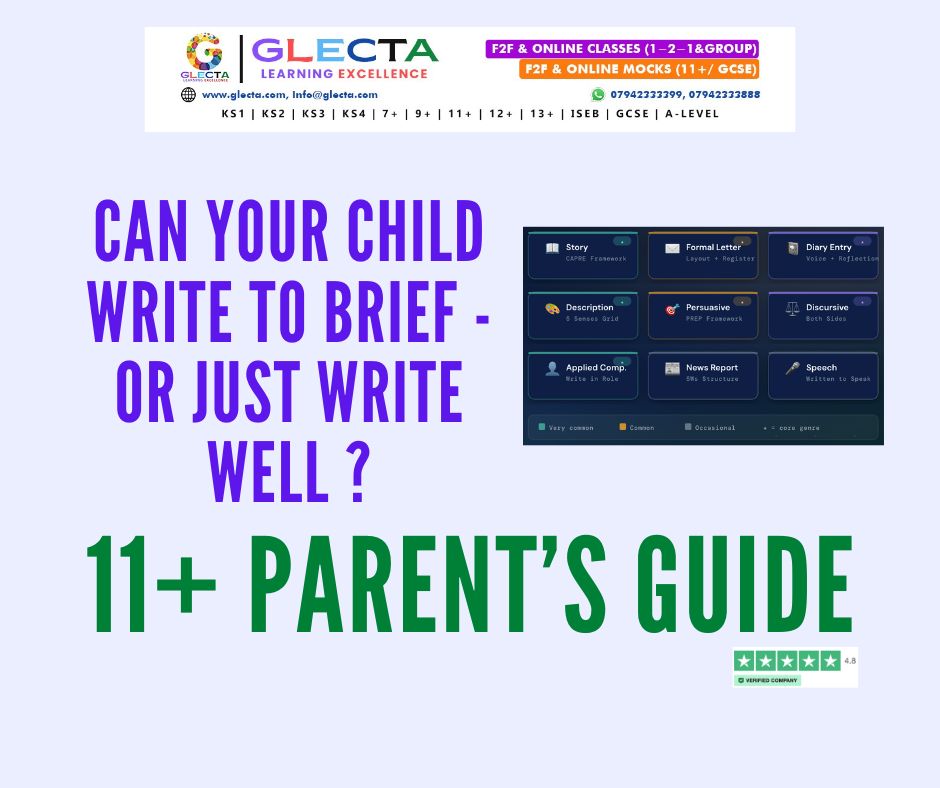
Every 11+ Writing Genre Summarised
Use this table to identify which genres your child practises most — and which still need work.
| Genre | Key features | Planning tool | Frequency |
|---|---|---|---|
| Narrative story | First or third person, character + plot arc, sensory detail, satisfying ending | CAPRE | Very common |
| Formal letter | Address, date, Dear Sir/Madam, purpose paragraphs, Yours faithfully/sincerely | Layout checklist | Very common |
| Informal letter | Friendly opener, conversational voice, contractions allowed, Dear [name] | Purpose → news → close | Very common |
| Diary entry | Date, first person, personal voice, set-up → key moment → reflection | Date + 3 beats | Very common |
| Description | Sensory detail, no full plot needed, clear progression, show-don’t-tell | Senses grid | Very common |
| Persuasive writing | One side argued, PREP structure, rhetorical devices, call to action | PREP | Very common |
| Discursive essay | Balanced view, both sides, discourse markers, reasoned conclusion | Intro→For→Against→Conclusion | Very common |
| Applied comprehension | Writing from a character’s viewpoint after reading an extract | Character attribute note | Very common |
| News report | Headline, 5Ws lead, neutral tone, short paragraphs, third person | 5Ws grid | Occasional |
| Speech | Written to be spoken, direct address, rhetorical devices, call to action | PREP variant | Occasional |
| Instructions / recipe | Imperative verbs, numbered steps, logical sequence, precise language | Step list | Occasional |
| Playscript | Speaker labels, minimal narration, stage directions in brackets | Scene setter + dialogue | Less common |
| School magazine article | Heading, subheadings, semi-formal voice, tight intro + 2-3 paragraphs | PREP variant | Less common |
| Recount | Chronological, time connectives, first or third person, brief reflection at end | Timeline | Less common |
| Review | Summary without spoilers, specific evaluation, balanced recommendation | Summary → evaluate → recommend | Less common |
Story Writing — Plan with CAPRE
Stories are the most commonly practised genre and often the hardest to write under exam pressure. Structure and simplicity are the keys to success.
Story prompts appear in many forms: a picture, an opening line, a title, a single word, or a scenario. Whatever the trigger, the examiner is testing whether your child can create a world, bring a character to life, build tension and deliver a satisfying, earned ending — all within roughly 350–400 words and twenty-five minutes.
The most common failure is a story that starts too slowly (three paragraphs describing the weather before anything happens), has too many characters, loses its thread in the middle, or ends abruptly because time ran out. CAPRE prevents all of these problems.
Action — begin in motion. Drop the reader into something already happening.
Problem — a complication, obstacle or revelation that forces a choice or change.
Resolution — show how the character addresses or responds to the problem.
Ending — a short closing beat. Show consequence. Earn the ending — do not rush it.
Show and Tell — not just Show: “Show, don’t tell” is advice many children have heard. In a short exam story with a limited word count, you often need to do both. Too much showing and nothing gets told — the reader loses the thread. Too much telling and the story feels flat. The rhythm that works: tell us something quickly, then slow down and show us one vivid moment that earns the telling.
What examiners are really looking for in stories: Events are not enough. The strongest exam stories have emotional movement — the character feels or understands something different at the end from what they felt at the beginning. That shift does not need to be dramatic. It just needs to exist. A child who has a clear problem, a moment of choice, and a resolution that shows consequence will outscore a child with an elaborate adventure that goes nowhere emotionally.
Understanding archetypes and tropes can unlock ideas instantly when the blank page feels daunting. Recognising the “hero facing an obstacle” pattern, the “unexpected friendship” setup, or the “something is not what it seems” twist means your child has story engines they can start immediately rather than inventing from scratch under pressure.
Four story techniques that earn marks at 11+
Letter Writing — Tone Matches Audience
Letter tasks always have an audience embedded in the brief. Identifying that audience in the first ten seconds changes everything about how the letter is written.
Formal letters are written to people in positions of authority: a headteacher, a local MP, a newspaper editor, a company director or a council official. The hallmarks are a conventional layout, measured and precise vocabulary, no contractions, and a courteous but purposeful close.
Date — written in full: 22 April 2026
Recipient’s name/title and address — below and to the left
Salutation — Dear Mr Smith / Dear Ms Jones. If unnamed: Dear Sir or Madam
Opening paragraph — state purpose in one sentence. No padding.
Body paragraphs — one clear idea per paragraph, precise vocabulary, no contractions
Closing paragraph — summarise desired action or outcome
Sign-off — Yours sincerely (named recipient) / Yours faithfully (unknown recipient)
I am writing to express my concern regarding the proposed closure of Ashton Park’s public library. As a resident who relies on the library’s resources, I believe this decision warrants careful reconsideration.
Informal letters are written to friends, family, or people the writer knows well. The voice is conversational, contractions are appropriate, personal details and humour fit naturally, and the sign-off is warm rather than formal. The key pitfall is confusing “informal” with “sloppy” — the writing should still be coherent, purposeful and well-organised.
💡 A powerful home exercise: Write about the same event twice — once to your headteacher and once to your best friend. Compare the opening lines, vocabulary choices, and sign-offs. The contrast sharpens both registers simultaneously.
Diary Entries — Voice, Feeling, Shape
A diary entry is a first-person private record of events and feelings. The voice should feel authentic — not like a formal essay accidentally starting with “Dear Diary.” The three-beat shape (set-up → key moment → brief reflection) gives a focused structure that works well under exam time pressure.
When the task asks your child to write as a character from a reading extract, the challenge deepens. They must adopt that character’s diction, age, emotional state and point of view — not write as themselves with the character’s name at the top.
Key moment — the event that changed or unsettled things
Reflection — how the writer feels about it now; what it means
I promised myself I wouldn’t go back. And yet here I am, sitting in the exact same spot on the harbour wall, watching the boat I should have been on disappear towards the horizon. Some promises, it turns out, are not as solid as they feel at the time.
Register consistency matters: If the character is a Victorian child, modern slang destroys the illusion. If the character is anxious, the sentence structure itself can mirror that anxiety — short, broken, uncertain. Encourage your child to think about how the character writes, not just what they write.
Descriptive Writing — Show As the Default
Descriptive writing does not require a plot. It tests atmosphere, focused sensory detail and vocabulary precision. The key difference from story writing: there does not need to be a character arc or a resolution — but there must still be a clear focus and a sense of progression. A description that visits five different places in a paragraph looks scattered; one that moves through a single scene methodically feels controlled.
Whereas in story writing we advocate “Show and Tell,” for pure description the default should be show as much as possible. Examiners are looking for the ability to evoke — to place the reader inside the scene through careful choice of sensory detail, not to explain that “it was scary.”
Sight — light/shadow, colour, movement, scale
Sound — volume, rhythm, unexpected sounds, silence
Touch/texture — temperature, weight, surface
Smell — often the most evocative and most underused
Taste — use sparingly; works best when character is present
Persuasive Writing — Take a Stand and Justify It
Persuasive writing asks the writer to argue one side and convince the reader. The position is stated early, the strongest reasons are selected and ordered, and the piece ends with a clear call to action. The key distinction from discursive writing (see below): persuasive writing argues one side; discursive writing weighs both sides.
Tone matters enormously. Matching register to audience — formal and measured for a headteacher, spirited but precise for a school magazine, authoritative for a public address — lifts a technically correct response into a genuinely impressive one. Exaggeration and name-calling undermine credibility, even in a piece written to persuade.
Reason — explain why this matters to the reader
Evidence — add a specific example, brief statistic or short scenario
Point again — restate the stance in stronger or more precise words, then move on
Repeat this cycle for each argument. Aim for two to three strong PREP cycles rather than five thin ones.
Rhetorical toolkit for persuasive writing:
- Rhetorical questions (“How many more children must miss out before we act?”)
- Rule of three (“It is unfair, unnecessary and entirely avoidable.”)
- Direct address (“You have the power to change this.”)
- Emotive language used precisely (“devastated” vs “quite upset”)
- Brief counterview + rebuttal, if time allows (“Some argue that... however...”)
- Discourse markers: “firstly”, “more importantly”, “this demonstrates”, “therefore”
Discursive Essays — Balanced, Reasoned, Clear
Discursive essays require the writer to explore a topic from multiple perspectives before offering a reasoned, fair conclusion. The tone is neutral (unless a personal view is specifically requested) and the piece signals its structure clearly to the reader through discourse markers and a logical paragraph order.
Viewpoint one — one to two paragraphs, concrete examples, linked discourse markers
Viewpoint two — one to two paragraphs, concrete examples, balancing language
Conclusion — weigh both sides; give a reasoned view if the task asks for one
Discourse markers for discursive writing:
- Opening: “The question of whether... is one that divides opinion.”
- Introducing first point: “To begin with”, “On one hand”, “Supporters of this view argue that...”
- Introducing second point: “On the other hand”, “However”, “In contrast”, “Nevertheless”
- Conclusion: “Having considered both sides...”, “On balance...”, “Taking everything into account...”
Applied Comprehension — Writing in Role
Applied comprehension tasks ask children to write from a character’s viewpoint after reading an extract. This is one of the most complex 11+ writing tasks because it combines reading comprehension with creative writing — the child must understand the text deeply enough to inhabit one of its characters convincingly.
Before writing, jot down four quick notes about the character: age, situation, emotional state, and what they want or fear. Keep these visible and check back during writing. If a specific format is given (diary, letter, short scene), follow it exactly — the format marks are there to be picked up.
Current situation — what has just happened in the extract?
Emotional state — frightened? hopeful? resentful? surprised?
Goal or fear — what does this character want, or what are they running from?
Then: match every word choice and sentence rhythm to that character. Read back over each paragraph and ask: does this sound like this person?
Build confidence systematically at home: Start by practising applied comprehension with a familiar book (so the character is already known). Once this feels comfortable, move to unfamiliar extracts. The familiarity scaffold prevents children from freezing on a character they have never met — a very common exam-day problem.
Less Common Tasks — Worth Practising
These appear less frequently but have specific conventions that are easy to learn and easy to lose marks on if they are unknown.
News reports aim for factual, concise accounts in neutral, third-person language. The structure follows the inverted pyramid: most important information first, supporting detail following.
- A short, punchy headline that names the story (not a clever pun for 11+)
- The 5Ws lead: who, what, where, when, why (and how) in the first paragraph
- Short paragraphs, one key idea each, past tense for completed events
- A brief attributed quote: “The headteacher commented that...”
- Neutral tone throughout — no opinions from the reporter
A speech is written to be spoken aloud. This means the rhythm of the sentences must work when read out. It shares structure with persuasive writing but leans harder into direct address, repetition and the dramatic pause — rhetorical effects that feel powerful when heard rather than read.
- Open with a direct statement of purpose or a rhetorical question
- Use second person (“You have the chance today...”) to involve the audience
- Signpost your points clearly (“First... Second... Finally...”)
- End with a strong, memorable call to action — not a quiet sign-off
Instruction writing is one of the most reliably structured genres — and one of the easiest to lose marks on by being vague. Every step must be actionable by someone who knows nothing about the task. If the instruction could be misinterpreted, it needs to be more specific.
- Use imperative verbs: “Place”, “Mix”, “Remove” — not “You should mix”
- Number each step. Do not use bullet points for instructions — sequence matters
- Include quantities, temperatures, and timings where relevant
- Test clarity by reading aloud — if you have to pause to understand it, rewrite it
Playscript format has its own visual conventions that must be followed exactly or the response loses presentation marks before a word of the dialogue is assessed.
- Speaker name in CAPITALS or bold, followed by a colon, then the dialogue on the same line
- Stage directions in italics or brackets: (crosses to the window)
- No speech marks around dialogue — the speaker label does the job
- Set the scene in a brief opening stage direction: time, place, atmosphere
- Keep stage directions minimal — the dialogue should carry the scene
A recount retells a real or imagined event in chronological order. It differs from a diary in that the focus is on what happened rather than how the writer felt about it — though a brief reflection at the end is appropriate. Time connectives are the structural glue: first, then, after that, eventually, finally.
- Establish the context quickly in the opening: who, where, when, why it matters
- Use time connectives to move events forward without repetition
- Keep to first or third person consistently throughout
- Close with a brief outcome or reflection — not a cliffhanger
The Pro Exam Strategy — Every Minute Planned
Most children know the rough idea of “plan, write, check.” Fewer know exactly how to use each phase. Here is a precise breakdown that works under real exam pressure.
Adaptability — What Top Students Do Differently
Genre knowledge is necessary. Adaptability — the ability to switch register fluidly and instantly — is what separates the top band from the rest.
When Glecta tutors review writing across hundreds of students, one pattern keeps appearing. Children who score in the upper range do not just know the genres — they adjust automatically. They read a prompt, lock in the genre within seconds, and the tone, structure and vocabulary that follow feel native to that genre rather than assembled. That naturalness is a trained skill, not a born talent.
Writes everything in essentially the same voice. The story sounds like the letter. The diary sounds like the essay. Each piece is technically present but tonally identical. Examiners notice immediately.
Adjusts tone, structure and vocabulary instinctively from prompt to prompt. The formal letter reads differently from the diary. The persuasive piece sounds nothing like the description. Adaptability is visible in every paragraph.
Three exercises that build adaptability fast
- 1The dual-audience letter. Write about the same topic twice — once to a headteacher, once to a best friend. Compare every element: the opening line, the vocabulary, the sign-off, even the sentence length. The contrast makes register differences viscerally clear in a way that abstract rules never do.
- 2The same event, three genres. Take a single event — arriving late to school, for example — and write it as a diary entry, a news report, and a persuasive letter to the headteacher arguing the bell is too early. Three radically different outputs from identical source material trains register switching directly.
- 3The two-mood description. Describe the same place from a calm perspective and then a tense one. The scene does not change — only the vocabulary and sentence rhythm do. This exercise makes children conscious of how word choice alone carries mood, which is a skill that transfers to every genre.
10 Writing Mistakes That Cost Marks
These are the patterns Glecta tutors see most often when reviewing children’s writing submissions. Most can be fixed with targeted practice.
Genre Identification Quiz — 10 Questions
Read each task prompt and identify the correct genre. This is the same first step your child should take in the exam itself.
The Parent Writing Playbook
What actually moves the needle when practising writing at home — based on the patterns we see across hundreds of Glecta students.
- 1Identify the genre before every session. Make “what genre is this?” the first question asked about every writing task, every time. This habit should become automatic before exam day.
- 2Rotate genres across the week. If you have daily sessions, a gentle weekly rhythm works well: Monday story, Tuesday formal letter, Wednesday diary, Thursday description, Friday persuasive or discursive. Variety prevents children writing everything in the same voice.
- 3Time every session correctly. Practice under realistic time pressure (25–30 minutes) from early on. Children who have only written at their own pace are often shocked by how little time the exam gives them. Timed practice builds pacing instinct.
- 4Insist on the plan — even a tiny one. Three minutes is not wasted time. A CAPRE note in the margin or a PREP outline prevents the most expensive exam errors. Habituate this until it happens automatically.
- 5Read the work aloud together. Reading aloud catches tense inconsistencies, missing words, sentences that do not make sense and dialogue that sounds nothing like the genre. Your child’s ear will catch things their eye misses on the page.
- 6Ask about effect, not just technique. After any writing session, ask: “What effect did you want this paragraph to have on the reader?” Connecting technique to intended effect is the habit that separates strong writers from technically competent ones.
- 7Focus on the weakest genre first. Identify which genre your child is least comfortable with and repeat it until the structure feels natural. Two or three sessions a week on one genre moves the needle faster than one session across all of them.
- 8Compare registers actively. Use the letter exercise: write the same story event once as a formal letter to a headteacher, once as a diary entry and once as a news report. The side-by-side comparison makes register differences tangible in a way that abstract rules never do.
💡 One session a week is better than none. If time is genuinely limited, choose the genre your child finds most difficult and repeat it until they are comfortable. Consistent, focused short sessions outperform infrequent marathon ones every time.
The Glecta Advantage
Writing is one of the hardest skills to improve without expert feedback. At Glecta, we build it systematically throughout the 11+ journey.
Our tutors do not just mark writing — they teach children to read the genre signal in any prompt, select and apply the correct framework under pressure, and deploy vocabulary and technique precisely within the right register. We support families from Year 3 foundation through Year 4 core, Year 5 advanced and intensive courses right through to National Offer Day, with free parent webinars on exam board specifics, mock interpretation, and writing feedback sessions.
Related guides
Quick links
Frequently Asked Questions
Ready to Give Your Child the Best Chance?
Join thousands of families who trust Glecta for structured 11+ preparation, expert mocks, personalised writing feedback, and parent support throughout the journey.