


08 July 2026 · 13–15 min read
Introduction
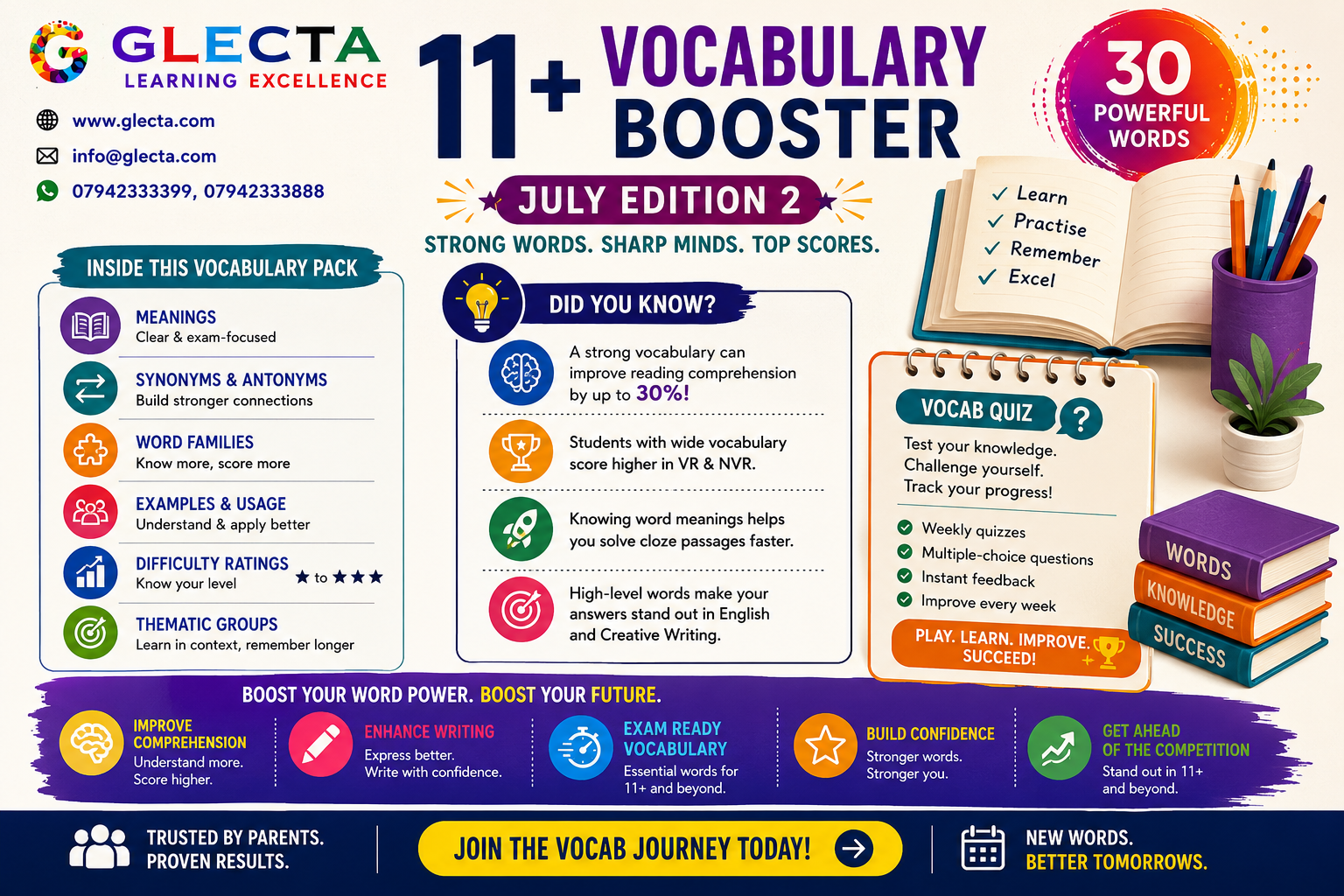
With live 11+ exams now just weeks away for many families, this second July batch focuses on the words that separate good answers from excellent ones. These are not obscure curiosities — they are the precision words that appear in comprehension inference questions, VR synonym traps, and cloze gaps where "almost right" is the same as wrong.
This July Edition 2 delivers 30 carefully selected words — each chosen because it appears in live GL, CEM, CSSE, FSCE, and independent school papers. Several are what examiners call distractor magnets — words children almost-recognise but misuse under pressure. That is precisely why they are here.
As with previous batches, every word carries a difficulty rating (★ to ★★★) so families know exactly where to spend energy. The Word Families section adds related forms because comprehension passages regularly serve up vindication where a child only practised vindicate. And the Thematic Groups section wires words into networks — because retrieval under time pressure works through association, not alphabetical lists.
Key for difficulty ratings:
- ★ Accessible — most Year 5 children will know this; reinforce and sharpen it
- ★★ Exam-level — high-frequency in VR and comprehension papers; deserves focused practice
- ★★★ Stretch — appears in harder papers and independent school assessments
Word List (30 Words)
GLECTA Vocabulary Builder – July Edition 2
| Word | Meaning | Synonyms | Antonyms | Difficulty |
|---|---|---|---|---|
| Vehement | Showing strong feeling or force; intensely passionate | Fervent, passionate, intense | Mild, indifferent | ★★★ |
| Benevolence | The quality of being kind and generous towards others | Kindness, generosity, goodwill | Cruelty, malice | ★★ |
| Catalyst | Something that causes or speeds up change or action | Stimulus, trigger, incentive | Hindrance, obstacle | ★★ |
| Detrimental | Causing damage or harm; having a negative effect | Harmful, damaging, adverse | Beneficial, helpful | ★★ |
| Emulate | To copy with the aim of matching or surpassing | Imitate, mimic, follow | Differ, disregard | ★★ |
| Furtive | Secretive and cautious because of guilt or hidden intent | Sneaky, covert, stealthy | Open, obvious | ★★★ |
| Genuine | Real, authentic, and sincere; not false or pretended | Authentic, truthful, legitimate | Fake, false | ★ |
| Harbour | To keep a thought or feeling secretly; to shelter or conceal | Cherish, shelter, conceal | Release, abandon | ★★ |
| Impartiality | Fairness and freedom from bias; treating all sides equally | Neutrality, fairness, objectivity | Bias, prejudice | ★★★ |
| Jeopardise | To put something valuable at risk of being lost or harmed | Endanger, threaten, imperil | Protect, safeguard | ★★ |
| Lingering | Continuing or remaining for longer than expected | Lasting, persistent, prolonged | Fleeting, brief | ★★ |
| Magnify | To make something appear larger or more significant | Enlarge, amplify, enhance | Reduce, diminish | ★ |
| Nurturing | Caring for and encouraging the development of someone or something | Supporting, fostering, encouraging | Neglecting, ignoring | ★ |
| Obliviousness | Complete lack of awareness of what is happening around one | Unawareness, ignorance, heedlessness | Awareness, alertness | ★★★ |
| Perceptive | Quick to notice and understand things; showing insight | Insightful, observant, discerning | Unobservant, unaware | ★★ |
| Quarrelsome | Inclined to argue or pick fights; easily provoked | Argumentative, hostile, combative | Peaceful, agreeable | ★★ |
| Replenish | To fill something up again after it has been used | Refill, restore, renew | Empty, deplete | ★★ |
| Staunch | Loyal, reliable, and unwavering in support | Faithful, steadfast, devoted | Disloyal, unreliable | ★★★ |
| Transient | Lasting only for a short time; passing quickly | Temporary, brief, short-lived | Permanent, lasting | ★★★ |
| Unblemished | Perfect and without any faults, marks, or flaws | Flawless, immaculate, spotless | Flawed, damaged | ★★ |
| Vindicate | To prove someone to be right or free from blame | Justify, exonerate, clear | Condemn, incriminate | ★★★ |
| Withered | Dried up, shrunken, or weakened from lack of nourishment | Wilted, shrivelled, faded | Flourishing, thriving | ★★ |
| Yielding | Easily persuaded or giving way under pressure; compliant | Compliant, accommodating, submissive | Firm, resolute | ★★ |
| Zealously | With great enthusiasm, energy, and dedication | Eagerly, passionately, earnestly | Half-heartedly, reluctantly | ★★ |
| Boisterous | Noisy, energetic, and full of cheerful high spirits | Lively, exuberant, rowdy | Quiet, subdued | ★ |
| Concise | Giving much information clearly in very few words | Brief, succinct, compact | Verbose, lengthy | ★★ |
| Deftly | In a skilful, quick, and nimble manner | Expertly, skilfully, adroitly | Clumsily, awkwardly | ★★★ |
| Exonerate | To officially free someone from blame or criminal charges | Acquit, absolve, vindicate | Accuse, condemn | ★★★ |
| Foreboding | A strong inner feeling that something unpleasant is about to happen | Apprehension, dread, anxiety | Confidence, reassurance | ★★★ |
| Resurgence | A revival or renewed strength after a period of decline | Revival, renewal, comeback | Decline, deterioration | ★★★ |
Did You Know?
- English (Author's Purpose) tip: comprehension questions often ask why the writer included a particular sentence, description, or example — not just what it says. The correct answer usually explains the writer's intention, such as creating suspense, adding humour, building tension, or helping the reader visualise a scene. Students who think like the author, rather than just the reader, consistently achieve higher comprehension scores.
- Maths (Coordinates) tip: many 11+ coordinate questions test careful reading more than difficult maths. A common mistake is swapping the x-coordinate and y-coordinate. Remember: x comes first and moves across, y comes second and moves up or down. Students who quickly trace "across first, then up" rarely make this simple but costly error, especially in grid and transformation questions.
- NVR (Shape Transformations) tip: a shape can undergo several changes at once — for example, it may rotate, change size, and switch from white to shaded. Many students notice only the most obvious change and miss the others. Top performers develop a routine of checking shape, size, direction, position, and shading in the same order every time. This systematic approach reduces guesswork and leads to much higher accuracy in complex NVR questions.
Word Families
Knowing one form of a word unlocks others. 11+ comprehension passages regularly use related forms — so if a child knows vindicate, they should immediately recognise vindication when it appears mid-passage. Learn the root; the family comes free.
| Word | Related Forms | Quick Note |
|---|---|---|
| Vehement | vehemently (adv), vehemence (n) | Vehemence (the noun) is the form most often found in non-fiction: "she spoke with such vehemence that the room fell silent" — worth drilling alongside the adjective |
| Benevolence | benevolent (adj), benevolently (adv) | Root: Latin bene = good + velle = to wish — contrast with malevolence (wishing harm), its direct antonym and a word that appears in its own right in harder papers |
| Catalyst | catalyse (v), catalytic (adj), catalysis (n) | Catalytic appears in science comprehension passages: "a catalytic reaction" — knowing the family prevents confusion when the base word changes form mid-passage |
| Detrimental | detrimentally (adv), detriment (n) | Detriment (the noun) is common in formal non-fiction: "to the detriment of her health" — recognising both forms avoids losing marks on cloze questions |
| Emulate | emulation (n), emulative (adj), emulator (n) | Emulation often appears in non-fiction passages about role models and achievement: "her success inspired emulation across the school" |
| Furtive | furtively (adv), furtiveness (n) | "He glanced furtively over his shoulder" — the adverb is a classic tension and suspense marker in fiction comprehension passages; spotting it signals hidden intent |
| Genuine | genuinely (adv), genuineness (n), genuinity (n — rare) | Genuinely is the form most often tested in tone questions: "she was genuinely surprised" — it tells the reader the emotion is real, not performed |
| Harbour | harboured (past tense), harbouring (v) | Works as both noun (a sheltered port) and verb (to conceal or keep secretly) — context is essential; both senses appear in 11+ comprehension and cloze passages |
| Impartiality | impartial (adj), impartially (adv), partial (antonym adj) | Partial (biased, or incomplete) is the antonym and appears in its own right: "a partial account of events" — knowing the prefix im- instantly doubles the vocabulary gain |
| Jeopardise | jeopardised (past tense), jeopardy (n), jeopardising (v) | Jeopardy (the noun: a situation of danger) is equally common in papers: "the project was in jeopardy" — recognising the shared root is essential |
| Lingering | linger (v), lingered (past tense), lingeringly (adv) | "She lingered at the door" — the simple past form appears regularly in fiction to signal hesitation or reluctance; the adjective form ("a lingering doubt") signals persistence |
| Magnify | magnified (past tense), magnification (n), magnifying (v), magnitude (n — related root) | Magnitude (great size or importance) shares the Latin root magnus = great — knowing this connects the two words and unlocks unfamiliar vocabulary in non-fiction passages |
| Nurturing | nurture (v/n), nurtured (past tense), nurture (n — opposite of nature) | The "nature vs nurture" phrase appears in science and psychology non-fiction passages — children who know this context gain an instant comprehension advantage |
| Obliviousness | oblivious (adj), obliviously (adv), oblivion (n) | Oblivion (the state of being completely forgotten or unaware) is a stretch noun worth knowing: "the old tradition had fallen into oblivion" — appears in history and culture passages |
| Perceptive | perceptively (adv), perception (n), perceive (v), imperceptible (adj) | Imperceptible (so slight as to be unnoticeable) is a high-value stretch form: "an imperceptible change" — breaking down the prefix im- + root perceive makes it immediately accessible |
| Quarrelsome | quarrel (n/v), quarrelled (past tense), quarrelling (v) | The base verb quarrel is the form most often found in fiction passages — "they quarrelled bitterly" — while quarrelsome describes a character's general disposition |
| Replenish | replenished (past tense), replenishment (n), replenishing (v) | Replenishment appears in non-fiction about resources and sustainability: "the replenishment of ocean fish stocks" — recognising it from the base verb saves time under pressure |
| Staunch | staunchly (adv), staunchness (n) | Also used as a verb meaning to stop a flow of blood: "he staunched the wound" — a different sense that occasionally appears in adventure fiction; context distinguishes it immediately |
| Transient | transiently (adv), transience (n), transitory (adj — synonym) | Transience (the quality of lasting only briefly) is a favourite abstract noun in poetry and literary non-fiction: "the transience of beauty" — worth drilling alongside the adjective |
| Unblemished | blemish (n/v), blemished (antonym adj) | Breaking it down: un- (not) + blemish (a mark or flaw) — a good prefix lesson. Blemished appears in its own right as the antonym form in comprehension answers |
| Vindicate | vindication (n), vindicated (past tense), vindictive (adj — related but different meaning) | Do not confuse vindicate (to prove innocent) with vindictive (seeking revenge) — they share a Latin root but mean very different things, and examiners use this as a deliberate trap |
| Withered | wither (v), withering (adj/v) | A withering look means a contemptuous, crushing stare — this figurative sense is distinct from the literal meaning and appears regularly in fiction character description |
| Yielding | yield (v/n), yielded (past tense), unyielding (antonym adj) | Unyielding (stubbornly firm; not giving way) is the direct antonym and appears in its own right — knowing the prefix un- makes both forms immediately accessible |
| Zealously | zealous (adj), zeal (n), zealot (n), zealousness (n) | Zealous (adj) and zeal (n) appear more commonly in papers than the adverb: "she pursued the project with great zeal" — all three forms share the same core meaning of intense enthusiasm |
| Boisterous | boisterously (adv), boisterousness (n) | "The children played boisterously in the yard" — the adverb is a common character atmosphere word in fiction; it signals energy and noise without necessarily implying bad behaviour |
| Concise | concisely (adv), conciseness (n), concision (n) | Concision (the quality of being concise) is a stretch noun worth knowing: "write with concision" appears in English language non-fiction and writing advice passages |
| Deftly | deft (adj), deftness (n) | Deft (the adjective) appears more commonly than the adverb in papers: "a deft touch", "a deft manoeuvre" — both describe smooth, quick skill; the adverb form is the stretch version |
| Exonerate | exoneration (n), exonerated (past tense) | Exoneration (the act of being freed from blame) appears in journalism and legal non-fiction passages: "her exoneration came too late" — recognising the noun form is essential for harder comprehension papers |
| Foreboding | forebode (v — rare), forebodingly (adv) | Used as both a noun ("a sense of foreboding") and an adjective ("a foreboding silence") — examiners use the adjective form to test atmosphere and tone recognition in fiction passages |
| Resurgence | resurge (v — rare), resurgent (adj) | Resurgent (becoming active or popular again after a quiet period) appears in non-fiction: "a resurgent interest in traditional crafts" — worth drilling alongside the noun as both forms appear in papers |
Thematic Groups
Comprehension passages use vocabulary in clusters. A courtroom or justice scene naturally brings vindicate, exonerate, and impartiality together. A tense atmosphere weaves in foreboding, furtive, and lingering. Learning words by theme means your child spots them by association during the exam, not just in isolation. Here are the four groups for this batch:
Group 1 — Emotions & Atmosphere
Foreboding, Vehement, Lingering, Obliviousness, Boisterous
These describe inner emotional or psychological states and the atmosphere they create. In comprehension, they appear as clues to a character's mood or the tone of a passage. Ask: is this emotion positive, negative, or somewhere in between? That question alone helps children narrow down the correct synonym under time pressure.
Group 2 — Character & Behaviour
Genuine, Furtive, Quarrelsome, Staunch, Nurturing, Perceptive, Yielding, Zealously
These reveal how a person behaves and what kind of person they are. In fiction comprehension, they are the inference vocabulary — what the passage is implying without stating directly. In creative writing, swapping a flat word like "loyal" for staunch or "secretive" for furtive immediately elevates the response.
Group 3 — Actions & Processes
Emulate, Harbour, Magnify, Replenish, Jeopardise, Vindicate, Exonerate, Withered
These describe what happens to things or people. In cloze passages, the gap is often one of these — check that the chosen word fits both the meaning and the grammar of the sentence. Several (Harbour, Magnify, Withered) carry both literal and figurative senses: the sentence must decide which is being used.
Group 4 — Abstract & Conceptual
Benevolence, Catalyst, Detrimental, Transient, Unblemished, Impartiality, Concise, Deftly, Resurgence
These are the highest-value group because they describe ideas, qualities, and states that cannot be pointed at. They appear most often in non-fiction passages (history, science, journalism) and in VR synonym questions. Knowing their noun forms — benevolence, catalyst, transience, impartiality, resurgence — is especially important for Year 6 and independent school papers.
Usage Examples
- Vehement: "Her vehement denial convinced nobody — her voice shook and she refused to meet anyone's eyes."
- Benevolence: "The school remembered him not for his wealth but for his quiet benevolence towards those who had less."
- Catalyst: "The unexpected letter proved to be the catalyst for a chain of events nobody had anticipated."
- Detrimental: "The long delays proved detrimental to the project, pushing costs well beyond the original budget."
- Emulate: "She had spent years trying to emulate her older sister's calm confidence in difficult situations."
- Furtive: "He cast a furtive glance at the clock, hoping no one had noticed he was desperate to leave."
- Genuine: "Her smile was genuine — not the polished kind that fades the moment a camera is put away."
- Harbour: "He had spent years learning to harbour his frustration quietly, rather than letting it show at the wrong moment."
- Impartiality: "The judge's impartiality was beyond question — she had recused herself whenever the slightest conflict of interest arose."
- Jeopardise: "One careless comment to the press could jeopardise the entire negotiation process."
- Lingering: "There was a lingering smell of smoke in the corridor long after the fire had been put out."
- Magnify: "The new lens could magnify even the smallest insect to extraordinary detail."
- Nurturing: "The nurturing environment of the school allowed even the most anxious students to grow in confidence."
- Obliviousness: "Her complete obliviousness to the growing panic around her was both impressive and alarming."
- Perceptive: "He was remarkably perceptive for his age — he noticed things that adults often missed entirely."
- Quarrelsome: "The quarrelsome neighbour had taken three separate disputes to the council in one year alone."
- Replenish: "After the long climb, they stopped to replenish their water bottles at the mountain stream."
- Staunch: "She remained a staunch supporter of the project even when everyone else had walked away."
- Transient: "Fame, he had learned, was entirely transient — celebrated one year and forgotten the next."
- Unblemished: "After twenty years of service, her professional record remained unblemished."
- Vindicate: "The newly discovered evidence was enough to vindicate the man who had spent a decade protesting his innocence."
- Withered: "The flowers in the window box had withered during the heat wave — brown-edged and leaning sadly over the pot."
- Yielding: "His yielding nature meant people often took advantage of him without realising they were doing so."
- Zealously: "She zealously defended every detail of the original plan, refusing to accept a single amendment."
- Boisterous: "The boisterous laughter from the back of the coach told the teachers everything they needed to know."
- Concise: "His report was admirably concise — three clear pages where others had written thirty."
- Deftly: "She deftly redirected the conversation before anyone realised a difficult question had been asked."
- Exonerate: "The CCTV footage was enough to exonerate him completely — he had never been near the building."
- Foreboding: "A deep sense of foreboding settled over the team as the storm clouds gathered above the summit."
- Resurgence: "The resurgence of interest in handwritten letters surprised everyone who had declared them dead."
5-Minute Drills
- Synonym sprint (90 seconds): Choose 5 words from the list. For each, say one synonym out loud instantly. If you hesitate for more than two seconds, that word goes back into tomorrow's set. Speed matters — the exam doesn't wait.
- Antonym snap (60 seconds): Parent says the word; child replies with the antonym. No "sort of…" answers. Clean, exact opposites only. Swap roles after five correct answers.
- Cloze builder (90 seconds): Write 3 short sentences with blanks, then swap with a parent or sibling. Example: "Despite the accusations, the new evidence was enough to ______ him completely." (answer: vindicate — but discuss: could exonerate also work, and is there any difference in shade of meaning?)
- Word family challenge (60 seconds): Parent says a base word. Child gives the noun form. Examples: vehement → vehemence; transient → transience; exonerate → exoneration; perceptive → perception. Three correct → swap roles.
- Spot the odd one out (90 seconds): Which word does not belong with the others — and why?
- Fervent / Passionate / Intense / Mild → Mild (it is the antonym of vehement; the others are synonyms)
- Temporary / Brief / Short-lived / Permanent → Permanent (it is the antonym of transient; the others describe something fleeting)
- Faithful / Steadfast / Devoted / Disloyal → Disloyal (it is the antonym of staunch; the others describe loyalty)
- Flawless / Immaculate / Spotless / Flawed → Flawed (it is the antonym of unblemished; the others all mean without fault)
Tip: in the real exam, the odd-one-out is usually the antonym disguised inside a list of synonyms. Training the eye to spot this is one of the most valuable VR habits a child can build.
- Use It This Week challenge: Pick these three words: vehement, transient, and foreboding. Before the next session, use each one in a real sentence — spoken at dinner, written in homework, or in a message. Bonus challenge: use all three in a single short paragraph about a character facing a difficult decision.
Quick Quiz (10 points)
- Vehement most nearly means…
- Antonym of staunch?
- Transient is closest to…
- Foreboding means…
- Antonym of vindicate?
- Impartiality most nearly means…
- The word family of resurgence includes…
- Exonerate means…
- Which word does NOT belong? Brief / Succinct / Compact / Verbose
- Antonym of detrimental:
Score: 0/0
Parent Playbook
- Use the difficulty stars first: begin each session with ★ words to build fluency and confidence, then move into ★★, and save ★★★ for when the foundations are solid. Confidence before challenge, every time.
- Watch the confusion pairs: this batch contains several words children mix up under pressure — vindicate vs vindictive, exonerate vs exasperate, transient vs transient vs transit. Drilling these as contrast pairs makes the distinction stick.
- Drill word families, not just base words: if your child knows exonerate, ask for exoneration. If they know vehement, ask for vehemence and vehemently. The exam rarely serves the base form in isolation.
- Test themes, not just lists: ask "give me three words that describe how a fair judge behaves" rather than running alphabetically. It mirrors how the words appear in real passages and builds faster retrieval.
- Stop "kind of" answers: push for exact synonyms and antonyms. Furtive doesn't just mean "sneaky" — it means secretive specifically because of guilt or hidden intent. Precision wins marks; approximate understanding loses them.
- Use "because": after any answer, ask "why does that word fit?" This trains the exam-style explanation that comprehension questions reward, and it stops guessing in its tracks.
- Mini-tests every Sunday: 10 questions, score recorded, trends spotted. Three weeks of consistent improvement is a reliable signal of genuine retention — not just short-term memory.
GLECTA Advantage
At GLECTA, we don't just hand out word lists and hope for the best. Vocabulary sits at the centre of how we teach — embedded into timed exercises, mock feedback, comprehension drilling, and the parent conversations that keep the whole journey on track.
We support families through Year 3 foundation, Year 4 core, Year 5 advanced, and high-intensity phases like intensive and half-term courses across our centres in Ilford, Barnet, Harrow, Bexley, and Medway. We also run free webinars to guide parents on exam boards, mock interpretation, timing strategies, and confidence-building — and we support families right through to National Offer Day.
- 11+ Courses (Overview)
- 11+ Year 3 (Foundation)
- 11+ Year 4 (Core)
- 11+ Year 5 (Advanced)
- 11+ Intensive / Half-Term Courses
- 11+ Mastery Courses
- 11+ Mock Tests
Reviews:
- 4.9★ Trustpilot: uk.trustpilot.com/review/glecta.com
- 5★ Google: g.page/r/CYwJSPULjEtDEBM
Related Guides
- 11+ Vocabulary Booster – July Edition 1
- 11+ Vocabulary Booster – May Batch
- 11+ Vocabulary Booster – March Batch A
- 11+ Prefixes & Suffixes That Unlock Cloze Passages
FAQs
What does the difficulty rating (★/★★/★★★) mean?
★ words are accessible — most Year 5 children should recognise them, but they still need sharpening. ★★ words appear regularly in GL, CSSE, CEM, and FSCE papers and deserve focused practice. ★★★ words are stretch-level, appearing in harder papers and independent school assessments.
What is the difference between vindicate and vindictive?
Vindicate means to prove someone right or free from blame. Vindictive means having a strong desire for revenge. They share a Latin root but mean entirely different things — and this is a deliberate 11+ trap. If in doubt, remember: to vindicate someone clears them; a vindictive person wants to hurt them.
What is the difference between exonerate and vindicate?
Both mean to free from blame, but with a nuance: exonerate tends to carry a formal or official sense (cleared by evidence or authority), while vindicate also carries the meaning of proving that a decision or belief was correct. In practice they are often interchangeable — but knowing the distinction can sharpen comprehension inference answers.
How many new words should my child learn each week for 11+?
A strong target is 10–12 words per week, but only if they are reviewed the following week. If recall is weak, reduce the new intake and increase repetition of what has already been taught. Retention beats coverage every time.
Are these words useful for GL, FSCE, CEM, CSSE, and independent exams?
Yes. Vocabulary supports comprehension and verbal reasoning across all exam boards. The exact paper format changes, but strong word knowledge — especially synonym, antonym, and inference vocabulary — transfers everywhere.
My child memorises meanings but can't use the word. What should we do?
Switch from definition recall to sentence production. One word, one sentence, one reason why it fits that context. The "Use It This Week" challenge in this blog targets exactly this gap — moving from passive recognition to active, accurate use under pressure.
What's the biggest vocabulary mistake children make in 11+?
Approximate understanding. Knowing furtive means "sneaky" isn't enough — it specifically means secretive because of guilt or hidden intent. Knowing transient means "short" misses the connotation of something passing through rather than simply ending. Precision and range of meaning win marks; vagueness loses them.
How do thematic groups help with comprehension?
Stories and non-fiction passages use vocabulary in clusters. A courtroom or justice scene naturally brings in vindicate, exonerate, and impartiality together. An atmosphere of tension draws on foreboding, furtive, and lingering. Learning words in theme groups builds associative networks in memory — and networks are far faster to retrieve under exam-time pressure than alphabetical lists.
What is the odd-one-out drill training for exactly?
It mirrors a real VR question type and builds the most important micro-skill in VR: spotting the antonym hiding inside a list of synonyms. Examiners use this pattern regularly because it catches children who have only a vague sense of a word's meaning. Precise understanding reveals the intruder instantly.
How can parents make vocabulary practice feel less like a chore?
Keep it short and frequent: a 2-minute quiz at dinner, three questions in the car, or a Sunday 10-question recap. Short and frequent sessions work significantly better than long, infrequent ones — and they avoid the resistance that comes when children feel the session will never end.
What if my child keeps confusing words with similar meanings?
Teach contrast pairs directly: transient vs permanent, staunch vs disloyal, vehement vs mild. Contrast makes memory stick far more reliably than repeated exposure to a single word in isolation. The brain learns difference as much as it learns definition.